
Step by step
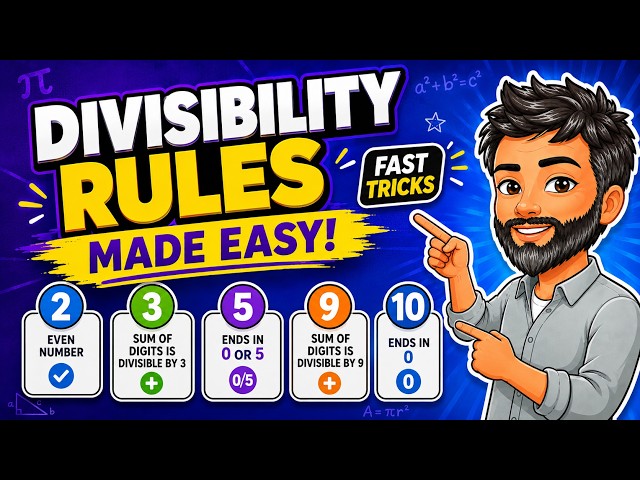
For 2, check if the last digit is even
A number is divisible by 2 if its last digit is 0, 2, 4, 6 or 8. Our number system is based on 10, and 10 is divisible by 2, so every place except the ones already is. 4,536 ends in 6, so yes.
▶ Watch this step 1:05For 3, add the digits
If the sum of the digits is divisible by 3, so is the number. For 234, 2 + 3 + 4 = 9. For 4,536, 4 + 5 + 3 + 6 = 18, and 18 ÷ 3 = 6, so yes.
▶ Watch this step 1:32For 4, check the last two digits
100 is divisible by 4, and so is every higher place value, so only the last two digits matter. For 3,524, 24 ÷ 4 = 6. For 4,536, 36 ÷ 4 = 9, so yes.
▶ Watch this step 1:56For 5, look for a 0 or 5 at the end
Counting by 5s goes 5, 10, 15, 20, 25, 30, and each ends in 5 or 0. Since 10 is divisible by 5, only the last digit matters. 4,536 ends in 6, so no.
▶ Watch this step 2:43For 6, pass both the 2 and 3 tests
6 = 2 × 3, so the number must be even and its digit sum must be divisible by 3. 144 is even and 1 + 4 + 4 = 9, so it works. 4,536 passed both tests, so yes.
▶ Watch this step 3:12For 8, check the last three digits
1,000 is divisible by 8, and so is every higher place value, so only the last three digits matter. For 45,128, 128 ÷ 8 = 16. For 4,536, 536 ÷ 8 = 67, so yes. A number ending in 000 works too.
▶ Watch this step 3:50For 9, add the digits; for 10, look for a 0
If the digit sum is divisible by 9, so is the number: 4,536's sum is 18, and 18 ÷ 9 = 2, so yes. A number is divisible by 10 if it ends in 0. 4,536 ends in 6, so no.
▶ Watch this step 4:36

“They're not magic. They're based on patterns in our number system.”
Worked example · with Tan the Turtle
Try one more, step by step
Problem: Test 7,140 for divisibility by 2, 3, 4, 5, 6, 8, 9 and 10.
- 2: The last digit, 0, is even. Yes.
- 3: 7 + 1 + 4 + 0 = 12, and 12 ÷ 3 = 4. Yes.
- 4: The last two digits: 40 ÷ 4 = 10. Yes.
- 5: It ends in 0. Yes.
- 6: It passed 2 and 3. Yes.
- 8: The last three digits: 140 ÷ 8 = 17.5. No.
- 9: The digit sum, 12, isn't divisible by 9. No.
- 10: It ends in 0. Yes.
Answer: 7,140 is divisible by 2, 3, 4, 5, 6 and 10, but not by 8 or 9.
Check: 7,140 ÷ 6 = 1,190, a whole number.
Common mistakes
- Calling a number divisible by 4 just because it's even. 4,538 is even, but 38 ÷ 4 = 9.5. For 4, test the last two digits. For 8, test the last three.
- Calling a number divisible by 6 after checking only one rule. Check both: even, and a digit sum divisible by 3.
- Assuming a number that passes the 3 test also passes the 9 test. 123's digit sum is 6, so it passes for 3 but not for 9. For 9, the digit sum itself must be divisible by 9.
- Mixing up 5 and 10. 4,535 is divisible by 5, but not by 10. For 5, the last digit can be 0 or 5. For 10, it must be 0.
Questions
Why does the divisibility rule for 4 only use the last two digits?
Every place from the hundreds up is a multiple of 100, and 100 ÷ 4 = 25, so those places never change the answer. That leaves just the last two digits to check, like the 24 in 3,524.
How can you tell if a number is divisible by 6?
It has to pass both the 2 test and the 3 test, because 6 = 2 × 3. So check that it's even and that its digits add up to a multiple of 3.
Read the full transcript
0:01 Hey everyone, welcome back to Math with Mr. DJ. So glad you're here. Today we're diving into one of my favorite topics in math, divisibility. And here's the cool thing. Once you understand divisibility, you can do some seriously impressive mental math. So stick around. Let's figure out how to tell if a number can be divided evenly without actually doing the division. Imagine you're at a party with 4536 cookies. Yeah, I know that's a lot of cookies, but just hear me out, okay? You need to divide them equally among your friends. But here's the thing, you don't know how many friends are coming. So, what if you could instantly know whether those cookies could be split evenly into groups of 2, 3, 4, 5, 6, 8, 9, or 10 without doing any actual division? See,
0:48 that's the power of divisibility rules. And today, we're going to learn them all. Divisibility rules are shortcuts that tell us whether a number can be divided evenly by another number. They're not magic. They're based on patterns in our number system. Let me show you each one and explain why they work. Divisibility by two. The rule is simple. A number is divisible by two if its last digit is even. 0 2 4 6 or 8. Why does this work? Because our number system is based on powers of 10. and 10 is divisible by two. So every place value except the ones place is already divisible by two. That means we only need to check the last digit. If the last digit is even, the whole number is even. Divisibility by three. Now, this one's a little bit trickier,
1:39 but it's cool. A number is divisible by three if the sum of its digits is divisible by 3. For example, the number 234. 2 + 3 + 4 = 9. And 9 is divisible by 3. So 234 must also be divisible by 3. It's really cool. Divisibility by four. A number is divisible by 4 if its last two digits form a number that's divisible by four. Why does this work? Because 100 is divisible by 4. And so is every higher place value, 1,00, 10,000, etc. So all those place values are already divisible by 4 and we only need to check the last two digits. For example, to check if 3,524 is divisible by 4,
2:30 we only look at the 24 the two the four at the end. Since 24 / 4= 6, the whole number 3524 has to be divisible by four as well. Divisibility by 5. A number is divisible by five if it ends in zero or five. And think about it. We count by fives. 5 10 15 20 25 30 those all end in five or zero. And here's why. Because 10 is divisible by five. And 10 is our base unit. So every 10's place, hundreds place, thousand's place, they're all divisible by five. So again, you only need to check the last digit. And if it ends in zero or five, then it's divisible by five. Divisibility
3:15 by 6. A number is divisible by 6 if it's divisible by both 2 and 3. Why? Because 6 equals 2 × 3. And 2 and 3 are both prime numbers. So for a number to be divisible by six, it must have both 2 and 3 as factors. This means the number must be even divisible by two and the sum of its digits must be divisible by 3. For example, 144 is divisible by 6 because it's even. And 1 + 4 + 4 = 9, which is divisible by 3. Divisibility by 8. A number is divisible by 8 if its last three digits form a number that's divisible by 8. Why? Well, because 1,00 is divisible by 8.
4:03 And so is every higher place value. So all those place values are already divisible by 8. And we only need to check the last three digits. For example, to check if 45,128 is divisible by 8, we only look at the 128, the 128 at the end. Since 128 / 8= 16, the whole number 45,128 is divisible by 8. And also don't forget if it ends in triple0 that is also divisible by 8 because a th00and is divisible by 8. Divisibility by 9. A number is divisible by 9 if the sum of its digits is divisible by 9. This works for almost the same reason as the divisibility by three rule, but with
4:48 a twist. When you divide any power of 10 by 9, you also get a remainder of one. So to figure out if a number is divisible by 9, you just add up the sum of the digits. And if that's divisible by 9, then the whole number is also divisible by 9. Divisibility by 10. A number is divisible by 10 if it ends in zero. This one's obvious when you think about it. 10 is our base number. So any number that ends in zero is a multiple of 10. It's literally how we count by tens. 10 20 30 40 50 so on and so forth. So if it ends in zero then it's divisible by 10. Let's do an example problem. Let's test if 4536 for divisibility by 2 3 4 5 6 8 9 and 10. All right let's work
5:39 through here step by step. Now divisibility by 2. Look at the last digit 6. Is 6 even? Yes. So 4536 is divisible by 2. We could write 4536 / 2 = 2268. So it's divisible by two. Okay. 3. Let's divisibility by 3. Let's add up the digits. 4 + 5 + 3 + 6 = 18. Is 18 divisible by 3? Yes. 18id 3 equals 6. So 4536 is divisible by 3. Divisibility by 4. Let's just look at the last two digits. 36 36 / 4 = 9. So yes, 4536 is also divisible by four. Let's look uh divisibility by five. Does it
6:30 end in zero or five? No, it ends in six. So it's not divisible by five. Uh divisibility by six. Didility rule for two and three uh work out? Yes, it did. So this number also has to be divisible by six. 4536 is divisible by 6 because it's also divisible by 2 and 3. Divisible by 8. You look at the last three digits. 536. That's divisible by 8. 536 / 8 is 67. Divisibility by 9. Well, we already found that the sum of the digits is 18 when we were doing the divisibility rule of three. So, is 18 divis divisible by 9? Yes. 18 / 9 equals 2. So, 4536 is divisible by 9. What about divisibility by
7:23 10? Does it end in zero? No. The last digit is a six. So, 4536 is not divisible by 10.
From the video’s captions.