
Step by step
Read the names word by word
A factor is a number that hops into your numbers. A multiple is a number your numbers hop into. The GCF is the greatest factor two numbers share, and the LCM is the least multiple they share.
▶ Watch this step 0:00List factor pairs and pick the greatest shared one
The factor pairs of 12 are 1 × 12, 2 × 6 and 3 × 4. For 18 they are 1 × 18, 2 × 9 and 3 × 6. Both share 1, 2, 3 and 6, so the GCF is 6. This means 12 blue and 18 pink counters can make 6 identical packs.
▶ Watch this step 0:41Use factor trees for bigger numbers
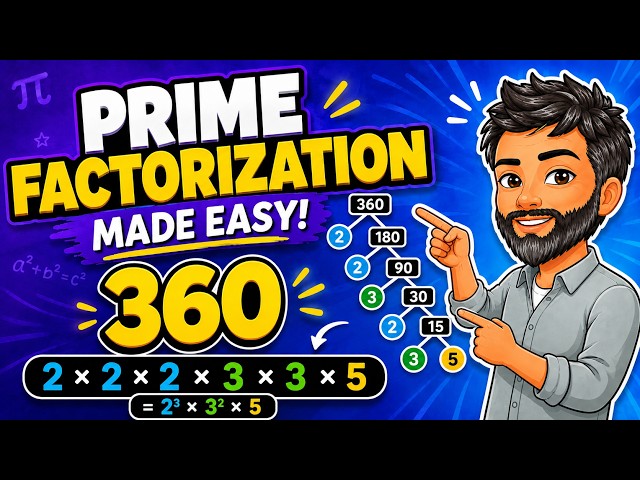
Split each number into two factors and circle every prime. 24 = 2 × 12, 12 = 2 × 6 and 6 = 2 × 3, so 24 = 2 × 2 × 2 × 3. For 36, Mr DJ splits 9 × 4 and gets 2 × 2 × 3 × 3. Any first split works.
▶ Watch this step 2:50Match shared primes to build the GCF
Pair a 2 with a 2, another 2 with a 2, and a 3 with a 3. The extra 2 from 24 and the extra 3 from 36 have no partner, so leave them out. Multiply the matches: 2 × 2 × 3 = 12. That's why 24 granola bars and 36 juice boxes fill 12 identical snack bags.
▶ Watch this step 4:41Count by each number to find the LCM
Count by 6s on a number line: 6, 12, 18, 24. Count by 8s: 8, 16, 24. The first number both land on is 24, so the LCM of 6 and 8 is 24. Zero doesn't count, because an LCM must be positive.
▶ Watch this step 7:55Check the LCM with prime factors
6 = 2¹ × 3¹ and 8 = 2³. Pick one power from every base, the largest one: 2³ and 3¹. So the LCM is 2 × 2 × 2 × 3 = 24, the same answer as counting.
▶ Watch this step 10:43Decide which tool the problem needs
Ask what the answer means before you calculate. A blue light flashes every 12 seconds and a pink one every 18 seconds. Counting 12, 24, 36 and 18, 36 shows they flash together again after 36 seconds, so this one is an LCM.
▶ Watch this step 13:56

“So GCF equal groups, LCM repeat together.”
Worked example · with Blaze the Dragon
Try one more, step by step
Problem: Find the GCF and the LCM of 16 and 24.
- Factor pairs of 16: 1 × 16, 2 × 8, 4 × 4.
- Factor pairs of 24: 1 × 24, 2 × 12, 3 × 8, 4 × 6.
- Shared factors: 1, 2, 4, 8. The GCF is 8.
- Count by 16s: 16, 32, 48. Count by 24s: 24, 48. The LCM is 48.
Answer: GCF = 8 and LCM = 48
Check: Size test: 8 isn't bigger than 16, and 48 isn't smaller than 24.
Common mistakes
- Multiplying to get the LCM: 6 × 8 = 48, but the LCM of 6 and 8 is 24. The product is a common multiple, not always the least. Count by each number to find the first match. Mr DJ warns about this
- Finding the LCM when the question asks for identical bags or packs. Equal groups need the GCF. Repeating together needs the LCM. Mr DJ warns about this
- Using unmatched primes in the GCF, like the extra 2 from 24. Multiply only the primes that appear in both factorizations. Mr DJ warns about this
- Getting a GCF bigger than the smaller number, or an LCM smaller than the larger one. Size test: for 6 and 12, the GCF can't be over 6 and the LCM can't be under 12. Mr DJ warns about this
Questions
What is the difference between GCF and LCM?
The GCF is the greatest number that divides into both numbers. The LCM is the smallest positive number both numbers divide into. For 12 and 18, the GCF is 6 and the LCM is 36.
How do I know if a word problem wants the GCF or the LCM?
Sharing things into the greatest number of identical groups, with nothing left over, is a GCF problem. Finding when repeating events line up again is an LCM problem.
Read the full transcript
0:00 Today we're going to find the greatest common factor and least common multiple. GCF and LCM. Here we have 12 and 18 and we're going to figure out what is the greatest common factor and least common multiple. The answers do different jobs. One of the things you need to remember is greatest common factor. You need to think about the words. It's the greatest one. It's the ones they have in common and they have to be factors. Factors are numbers that hop into these numbers. LCM, least common multiple. Least being the smallest one. Common being they have this in common. And a multiple is numbers that these like are going to hop into. So, they're different things. Let's start off with GCF. Here are 12
0:46 tiles in three rows of four. One, two, three of them. 3 × 4 is equal to 12. So, when you break 12 up into three parts, you're going to get four in each part. So, dividing 12 by either factor gives a whole number with no remainder. You want to find factors in the pairs. 1 × 12 right, is equal to 12. 2 × 6 is equal to 12. 3 * 4 is equal to 12. You're getting 1 and 12, 2 and 6, 3 and 4. So, the factors of 12 and 18, so so far we figured out 12. We have 1 × 12, 2 × 6, and 3 × 4. Those are the factors of 12. Now, you need to figure out the factors of 18
1:31 so that we can figure out which ones are they have in common. All right, here are the factors of 18. We have 1 * 18, 2 × 9, and 3 × 6. Now, remember you want to say to yourself, "Okay, which ones do they have in common?" We'll take a look. They have a one in common. They have a two in common. A three in common. And they have a six in common. And the greatest common factor of each of these is going to be six. So, remember, it's the greatest one that they have in common that is a factor of those numbers. The GCF of 12 and 18 is six. Six divides both exactly. 12 / 6 is two and 18 / 6 is three. Here's what the
2:16 answer can do. We have 12 blue counters and 18 pink counters. Let's say we wanted identical packs with the same number of each color in every pack using every counter. How many packs can you make? You can make six identical packs because six is their greatest common factor. There would be two blue in each pack and three of the pink in each pack. Let's talk about prime factors. Knowing prime factors is like the building block of any number. Listing works well for small numbers and prime factorization gives us another method. We can break each number into prime factors and then use the shared copies to build the greatest common factor. Let's take a look at this. So, the prime factors of 24 is 2 × 2 × 2 * 3. Let's quickly take a look at how you
3:01 get that. 24 can be broken down into a 2 × 12 and then I'm going to circle the two because it's prime. 12 can be broken down into a 2 × 6. Circle the two because it's prime. And the six can be broken down into a 2 * 3. Two is prime and so is three. Take a look, same thing. 2 × 2 * 2 × 3. That's how you get the prime factorization. You can break it down to all of its prime numbers. Now, how would we figure out the prime factorization of 36? 2 × 2 × 3 × 3. All right, let's break that one down. Here's 36. And by the way, you can break it you could as long as you get two factors that multiply to get you 36, it doesn't matter what you use. I could use 6 × 6 here or I could use 18 * 2. It
3:47 it doesn't matter or 9 × 4. All right, let's go with that last one. Let's just do 9 × 4. Let's see what happens. 9 * 4. Now, 9 is not prime. 4 is not prime. So, you don't circle them. 3 × 3. Those are both primes, so I'm going to circle them. And then 2 × 2. Both prime, so I circle them. See, we have the same thing over here. 2 × 2 × 3 × 3, which makes sense because 2 × 2 is 4 and 3 × 3 is 9 and 9 × 4 gets us back to 36. So, the prime factors of 24 and 36, again, are 24 is going to get us 2 squared × 3. So, 2 squared × 3. And the
4:32 prime factors of 36 are going to be 2 squared × 3 squared. So, when we using the prime factorization of 24 and 36, you want to look to see what do they have in common? They share a 2 and a 2 in common. They share another 2 and another 2 in common. And then they share a 3 and another 3 in common. This 2 over here does not match with another 2 on that side, so we can't use it for the GCF. This 3 does not match over there with any of the other 3, so we can't use that either to match. What you're going to do is you're going to take this 2 and this 2 and they match to make one 2 right there.
5:18 Then you can take this 2 and this 2 to match to make that one. And then you can take this 3 and this 3 to match to make a 3. And then you're just going to multiply that straight across. 2 × 2 is 4 × 3 is gets us 12. See, take a look right there. So, the greatest common factor of 24 and 36 is equal to 12. 12 is the largest number that hops into both 24 and 36. If you're counting by 12s, you would say 12, 24, 36. There is no other number that hops into both 24 and 36 that is larger than 12. Okay. We have 24 granola bars and 36 juice boxes. What's the greatest number
6:05 of identical snack bags we can make without leftovers? So, each bag needs the same number of bars and the same number of juices. So, think about it. You're trying to find the greatest common factor of that of 24 and 36, which we just did. So, I want you to really understand what's happening here. So, it's going to be the same contents in every bag, no leftovers. So, if we found out that 12 was the greatest common factor of 24 and 36, you're going to have 12 bags in all. So, how many bars are going to be in that one of the bags and how many juices are going to be one of the bags? So, take a look. We have 12 bags right here. 1 2 3 4 5 6 7 8
6:50 9 10 11 12. Those are your 12 bags. And because 12 was the greatest common factor of 24 and 36, you would have two of the blue ones in every bag because 12 hops into 24 two times. And you would have three of the juices because 12 hops into 36 three times. The greatest number of bags, 12 identical bags, right? Two bars per bag and three juices per bag. The least common multiple. We just talked about the greatest common factor. Now, we're talking about the least common multiple. Least being the smallest, common being what they have in common, and a multiple now. What numbers do those ones hop into? So, like in that last example, when we had 24 and 36, we
7:37 wouldn't we would we were talking about numbers that hopped into 24 and 36. These common multiple, we're talking about numbers that 24 and 36 would be hopping into. The first one they would both hop into. So, the first shared positive multiple. So, if we were counting by sixes along this number line, we would have we would go six, 12, 18, 24. Each step is adding six, right? Plus six, plus six, plus six, plus six. And every landing point is a multiple of six. Like zero marks the starting point, but an LCM must be positive. Now, let's
8:22 count by eights on the same scale. Eight, 16, 24. And that would keep going, right? You go to 32, 40. But we can stop there. Remember, these are going plus eight, plus eight, plus eight. Did you notice that we ended up hopping on the same number when we were hopping by sixes? Both patterns land on 24. Like no earlier positive stop appears on both lines. Okay? So, look, they both started at zero, and then it was six and eight, no matches there. 12 and 18, no matches. 18 and 16, no matches. But 24 and 24, they both hop onto 24 when you start from zero. So, that means that is the first multiple
9:09 that eight and six have in common. And since it's the first one, it's the least. It's the least common multiple of eight and six. So, the list records those landing points. 6, 12, 18, 24. And again, both of them would keep going on, but you don't need to keep going on because you found the least common multiple. It is 24. The LCM of six and eight is 24. Dividing 24 by six gives four, and 8 gives 3. That confirms a common multiple. Our complete list established the least positive one. Let's check it out by doing the prime factors of both 6 and 8. Again, for 6, you would just break it down 2 × 3 and circle both of them. The prime factorization of 6 is 2
9:56 * 3. And if we were breaking down 8, you would do you could do 4 × 2, circle the 2, and do 2 × 2, and that would be 2 to the third or 2 × 2 * 2. So, the prime factors of 6, like we said, is 2 to the first × 3 to the first. The prime factors of 8 2 × 2 × 2. To build 8, we need three copies of 2. To build 6, we also need one three. One of those twos already combines with the three to make 6. We can use that shared two once in our common multiple. So, when we're doing LCM, we can use this three, and we can use this 2 × 2 * 2. We can't use this two over here because it is shared with one of these
10:43 over here. And this is different than GCF when you're using the prime factorization to find LCM. So, remember that. Another way that I I like to think about it is the prime factorization of 6 is 2 to the first × 3 to the first, which to the first just means, you know, itself. And the prime factorization of 8 is 2 to the third. And what I like to say is you have to pick one from like every base, and you want to pick the largest one. So, are you going to choose 2 to the first or 2 to the third? You choose 2 to the third when you're doing LCM. And then, we have to choose either 3 to the first or nothing over here that has a three. So, you choose 3 to the first. So, we end up getting
11:28 2 × 2 × 2 × 3, which gets us 24. That is the LCM of 6 and 8. Is the product always the LCM? LCM of 6 and 8 would be 48 if that was the case. And we just proved that the LCM of 6 and 8 is actually 24. It is not 48. However, 48 is a CM of 6 and 8. It is a common multiple. They both will hop into it obviously because when you do 6 × 8 you're doing six groups of eight or eight groups of six. So they both have to hop into 48. But again, that is a common multiple. It is not the least common multiple. 48 divides evenly by 6 and 8. So does 24, which is
12:13 smaller. Sometimes one number already divides the other. 6 * 2 = 12. That means 6 divides both 6 and 12. And 12 is already a multiple of both. So what do you think the GCF of 6 and 12 would be? And what would be the LCM of 6 and 12? The GCF of 6 and 12 is just 6. It's the greatest common factor. 6 hops into 6 one time and 6 hops into 12 two times. And what about the LCM? Well, the LCM is the first one they both hop into. 6 hops into 12 two times and 12 hops into 12 one time. Let's take a look at the factors of 8 and 15. Their only common factor is one. So
13:00 their GCF is one. The greatest common factor of 8 and 15 is just one. And that happens. It's actually good information to know, especially when you're reducing fractions. Cuz that tells you that that fraction is reduced all the way. The GCM and LCM of 8 and 15 well, the GCF like we just said is one and the LCM is going to be 120. Well, why is it 120? Well, if they don't have any in common, if the GCF is one, that means you are just multiplying 8 × 15. They're not going to hop into anything other than the first time they hop into a multiple is going to be its uh 8 × 15. It's going to be itself. Because with no
13:46 shared prime factors, and we figured that out because the GCF was one, multiplying 8 and 15 doesn't repeat any shared prime copies. So, their LCM is 120. So, for this pair, multiplying the two numbers does give the least common multiple. A blue light flashes every 12 seconds. A pink light flashes every 18 seconds. They flash together now. How many seconds until the next flash together? We're looking for the first future time in both repeating patterns. So, think about it. The blue light is going to flash every 12 seconds. So, it'll flash at 12, 24, 36, 48. Pink light is going to flash every 18 seconds. When would be the next
14:32 shared flash at the same moment? Let's take a look. Let's Let's count the 12s. 12, 24, 36. And let's do the 18s. 18, 36. So, right there, that's their least common multiple. That's the first number they both hop into. It's going to flash every 36 seconds. Now, before calculating, decide what the answer represents. Are we dividing quantities into the greatest number of identical groups, or finding the first shared total in repeating patterns? The meaning tells us which tool fits. Like, which one are you looking for? Are we looking for the greatest common factor or the least common multiple? Remember, equal groups require a number that divides both totals, a common
15:18 factor. Repeating together requires a number that both totals divide into, a common multiple. So then you choose greatest or least as the question requires. So GCF equal groups, LCM repeat together. For positive whole numbers, a GCF cannot exceed the smaller number. That is like really important to understand. So like in this example right here, the GCF of 6 and 12 cannot be larger than 6. Greatest common factor of 6 and 12 cannot be larger than 6 because no number greater than 6 is going to hop into 6. For LCM, an LCM cannot be below the larger number. Equality is possible. Like they can be it can be equal to it. So for
16:05 example in this one right here, the LCM of 6 and 12, it can be 12, but it can't be anything lower than 12. Can't be 11, 10, 9, 8, 7, 6. So here's your GCF and LCM checklist. When you're doing GCF, you're looking for factors, numbers that hop into those numbers. When you're doing LCM, you're looking for multiples, numbers that those numbers are hopping into. You want to find the numbers in both lists, and then you're choosing greatest or least, and then make sure you're checking your work. Here's your turn. So you're going to want to pause and whenever you need more time, and you want to try the mild, medium, or spicy challenge, up to you. Make sure you show your lists or prime factors. Sometimes you have to decide
16:51 like do I want to just like count these out and make a list, or do I want to do prime factorization of each of these? All right, you're finding the GCF of 10 and 15. You're trying to find a number that 10 and 15 have in common. It's one of their factors, and you want to pick the largest one. Medium problem. The LCM of 9 and 12. So you're looking for the least common multiple of 9 and 12. What number do they both hop into? 9 and 12 hops into. And you're looking for the smallest one. All right, spicy. Can you find the GCF and LCM of 18 and 24? And then also, tell me in the comments, why why do the answers differ? Why do you get different answers for GCF
17:36 and LCM of 18 and 24? Okay, for the mild one, the GCF of 10 and 15 is five. Right? Five is the greatest number that hops into both 10 and 15. Other than other than five, actually only one would hop into both 10 and 20. Um but five is the greatest. Five is greater than one. All right, here's the medium one. LCM of 9 and 12. LCM of 9 and 12 is 36. If you're counting by nines, right? You'd go 9, 18, 27, 36, 45, right? 54. You'd keep going. Um then if you're doing the 12s, you go 12, 24, 36. Oh, wait. 36 and 36. Oh, that's the least common
18:21 multiple of both 9 and 12. Okay, don't forget to do the spicy challenge. 18 and 24. GCF and LCM. Explain your reasoning. Put it in the comments. Try to try to do it before you look at my solution in the pin comments. Here's a Here's a recap. The GCF finds the greatest shared factor. LCM finds the least shared positive multiple. So, think about equal groups or repeating patterns. Then let the meaning guide your method. All right. Thank you so much for learning with me. If you found value in this video, please take a moment. Like, subscribe to the channel, share this with your friends, and don't forget to check out mathwithmrj.com. We have all kinds of math puzzles, daily
19:06 ones that are coming out every single day. And if you like Sudoku, if you like area challenge puzzles, all kinds of uh fun things on mathwithmisterdj.com. We also have some free worksheets. If you want to get some extra practice in, check it out. mathwithmisterdj.com.
From the video’s captions.