Step by step
Learn the parts
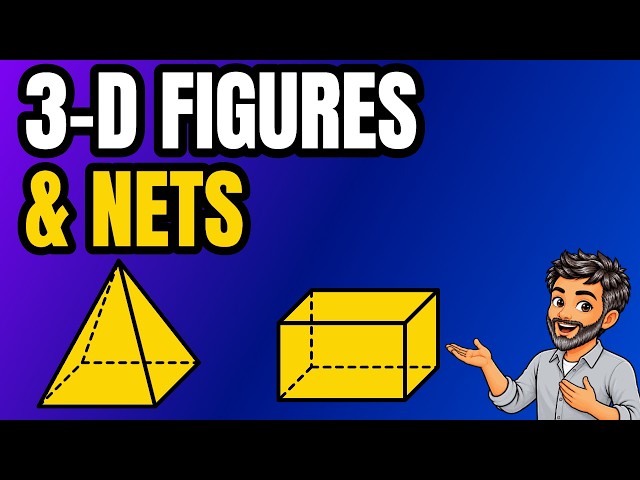
3-D figures have length, width and height. A face is a flat side, an edge is where two faces meet, and a vertex is where edges meet (more than one are vertices). Dashed lines show edges around the back that you can't see.
▶ Watch this step 0:39Tell a prism from a pyramid
A prism has two matching bases, the same shape and size on opposite ends, and everything connecting them is a rectangle. A pyramid has one base, and its triangles lean in to meet at one point.
▶ Watch this step 2:48Name it by its base
The base gives you the first word, and prism or pyramid gives you the second. A square base with triangles meeting at a point is a square pyramid.
▶ Watch this step 4:00Count faces, edges and vertices
A rectangular prism has 6 faces in pairs (top and bottom, front and back, two sides), so you can count one of each and double it. It has 12 edges (4 on top, 4 on the bottom, 4 going up) and 8 vertices (4 on top, 4 below).
▶ Watch this step 4:41Compare figures with the same base
A triangular prism has two triangle bases and 5 faces, 9 edges and 6 vertices. A triangular pyramid has 4 faces, 6 edges and 4 vertices. Same triangle base, different figure.
▶ Watch this step 6:46Unfold it into a net
A net is what you get when you cut a 3-D figure along some of its edges and lay it flat, so a cube's net has 6 squares. A square with triangles around it folds up into a square pyramid.
▶ Watch this step 8:57Test a cube net
Pick one square to be the bottom, then fold everything else up around it one at a time and watch where each square lands. Six squares in six different spots makes a cube. If two squares land on the same side, it doesn't.
▶ Watch this step 10:45Find a missing face with pairs
In a rectangular prism, opposite faces are exactly the same size. For a box 4 long, 3 deep and 2 tall, the faces are 4 × 2, 4 × 3 and 3 × 2, each twice. Find one of a pair and you know its twin, so the missing face is 3 × 2.
▶ Watch this step 12:44

“Remember, you want to fold it in your head before you trust it.”
Worked example · with Tan the Turtle
Try one more, step by step
Problem: A box is 5 long, 3 deep and 2 tall. Its net shows five faces: 5 × 3, 5 × 3, 5 × 2, 5 × 2 and 3 × 2. What size is the missing face?
- A rectangular prism has 6 faces and the net shows 5, so one is missing
- Opposite faces come in matching pairs
- 5 × 3 appears twice (top and bottom), so that pair is complete
- 5 × 2 appears twice (front and back), so that pair is complete
- 3 × 2 appears only once, so its twin is missing
Answer: 3 × 2
Check: Now every face size appears exactly twice: 2 + 2 + 2 = 6 faces.
Common mistakes
- Assuming any net with six squares folds into a cube. Six is the right number, but the arrangement matters. Fold it in your head from a bottom square and make sure no two squares land on the same side. Mr DJ warns about this
- Missing the faces and edges around the back when you count. Dashed lines show the hidden edges, and every face of a rectangular prism has a twin on the opposite side. Mr DJ warns about this
- Calling a figure a prism just because it has a triangle base. Count the bases. Two matching bases make a prism; one base with triangles meeting at a point makes a pyramid. Mr DJ warns about this
- Naming a figure by its side faces, like calling a square pyramid a triangular pyramid because its sides are triangles. The base gives you the first word. A square base with triangle sides is a square pyramid.
Questions
What is the difference between a prism and a pyramid?
A prism has two matching bases on opposite ends, joined by rectangles. A pyramid has one base, and its triangles all meet at one point.
Does every net with six squares make a cube?
No. Six is the right number, but the arrangement matters. If two squares land on the same side when you fold it up, it won't close into a cube.
Read the full transcript
0:00 These are 3D figures. Well, they represent 3D figures. Real 3D figures you can actually hold in your hand and you can like touch them. They take up space. 2D figures is like a square. It's like flat. And 2D figures have length and width. See as you can see right here, the square is flat. It lies on a flat page. But a 3D figure, it this cube right here, it has length, it has width, and it has height. So, that's the difference and that's why it's called 3D. It means three dimensions, length, width, and height. Each flat side is a face. You see this yellow section right here? That's one face on this cube. So
0:46 is the top, and so are the sides, and there's other faces on this cube that we just can't see right now. But if you had an actual physical cube, you could turn it around and see the other sides. So, this cube actually has six faces. It has 1 2 3 and it has the opposite of each of those three. Like for example, this front yellow one has a back one. This top one has under underneath, and this one on the right, there's one on the left there. Okay, where two faces meet, like right here, this yellow line, we call that an edge. So, yeah, so where two faces meet, that's an edge. Here's another edge. Here's another edge. One up top, one here. There's lots of them. Lots of edges.
1:32 It's kind of like the lines. And where edges meet, you get a corner, right? So, take a look at this one. This edge meets this edge, which meets this edge. This is a vertex. And when you have more than one vertex, we're talking about vertices. So, if I'm talking about one, it's vertex. If I'm talking about three, I would say three vertices. Some edges are around the back where you can't see them. So, remember, like this one right here, this one's around the back. And sometimes we use the dash lines for edges that are out of sight so that you can see the actual like 3D representation of what the cube is supposed to look like. And you can see all the faces and the edges
2:18 and the vertices as well. Let's take a look at example here. Right? There's an edge. There's an edge. Edge. Edge. Edge. Right? And then these yellow dash lines, that's the back one. There's another one. There's another one. You got the ones up top, right? There's all kinds of edges. If you're looking for the vertices, that's where two edges meet, right? There's a lot of them. These are all vertices. These little corners right there. A prism has two matching bases. So, this one right here, look at this base. It's a triangle. And then it has its match over on the other side right here. That makes it a prism. It has two matching bases. And these ones are both triangles. So, there's a top and a
3:05 bottom. They're the same shape, same size on opposite ends. Everything connecting them is a rectangle. So, you take a look at this. Here's a rectangle. Right here. And then there's a rectangle here. Yep. And then there's one in the bottom like this. A pyramid has one base and it comes to a point. So, take a look here. Here's the pyramid's base. As we can see from this, this this pyramid has a rectangular base. But then all of these triangles come up to a point. Can you see that? So, this is a pyramid. All of the
3:51 triangles are leaning in to meet at one point, right here. The base shape gives its name. Here's the naming trick. Look at the base. Is the base a triangle? Then it has to be a triangular prism. Is the base a rectangle? Then it has to be a rectangular prism. Is the base a square base? If it's a square base, again, it needs to have an opposite end to be the rectangular prism. But, because these all meet towards the center and meet at the point here, it's a pyramid, a square pyramid. The base gives you the first word.
4:37 Prism or pyramid gives you the second. Example one. So, this is a rectangular prism. We have a rectangular base, and we have the opposite. How many faces does this rectangular prism have? Hm, let's take a look. Well, we've got one face up top here. Right? There's one. And then we have one here. Two. We have one there. That's three. Off to the side here, we have four. And then we have one in the back. There's five. And then we have one underneath. There's six. It has six faces. Yeah, look at that. So, the way you can do your rectangular prism is say like, "Oh, I know that this
5:24 face right here has a top and a bottom, so I can just double it." Same with this one. It has a front and a back, so you just double it. And then the side has a front. Well, I'm sorry, has a side and another side. So, faces is six. How many edges does this rectangular prism have? Take a moment and count them. Let's do this one together. How many edges does this one have, this rectangular prism? Well, look, there's an edge here, one, two, three, four, and then let's do this one, five, six, seven, eight, and then all the bottom,
6:09 nine, 10, 11, 12. 12 edges. There's four on top, four bottom, and then four are going up. How many vertices does this have? Take a moment, think about it. We're going to go through this one together in just a second, but I want you to see if you can figure it out. How many vertices? All right, let's take a look. Vertices, that's where the edges meet. One, two, three, four, five, six, seven, eight. Eight vertices. Four on top, four below. Example two. Both of these have a triangular base. One is a prism, and one is a pyramid. Which is which?
6:55 And let's also figure out how many faces, edges, and vertices does each one have. What do you think? Did you figure out which one's a prism or a pyramid first? All right. If you said A is the prism, you are right. It has two matching bases. There's one, and here's the second right there. So, that makes it a prism. And as you can see up here, we have five faces, right there. Let's count them. We have one, we have two, we have three down here, four, with the triangles, and then five on the other side. Five faces. Edges, nine. Nine edges. And let's do it
7:42 in red this time. One, and then we go two, three, four, five, six, seven, eight, and then the back side is nine. Nine edges. All right, vertices. Let's take a look. One, two, three, four, five, six. Six vertices. Nice. Now, the triangular pyramid has four faces. It's the It's this side of the triangle. And it's like this side right here, over here, that you can't really see. And then it's like this back side. There's three of them. And then underneath. That's the fourth face.
8:27 Has six edges. Right? One, two, three, and then it has four, and five, and then six. It has four vertices. One, two, three, four. All right. Same triangle base, but different figure, right? So, they have the same triangular face. I mean, same triangular base. This one's the prism. This one is the pyramid. Let's talk about nets. A net is what you get when you cut a 3D figure along some of its edges. And you lay it out flat. Every face is still there. It's just unfolded. Count them with me.
9:12 One, two, three, four, five, six. Six of them. Now, fold the lines. The blue square stays down on the table. The green sides stand up. And the purple lid, it just swings over, and it closes up, and it becomes a cube. It's what you would have if you had this box, and you kind of cut along the edges here and cut it open, right? You'd be able to create this net if you unfolded it. Example three, what does this fold into? Take a look at it. We have the base here. We have some triangles here on the side. I want you to imagine the base sitting
9:58 flat and all the triangles being folded up. All right, so there's your base. Now imagine all of these triangles getting folded up into itself. Yeah, you'd get a square pyramid. You can see that there's a square for the base and then those triangles just fold it up and they met at a point at the top. So it'd be a square pyramid. Example four, which nets make a cube? There's three nets here, A, B, and C. Which ones would actually fold into a cube? Do you think it's A, B, or C? I'm going to pause here for a moment and let you decide.
10:44 Here's A. Here's the method. You pick one square to be the bottom and that stays on the table. Then you fold everything else up around it one at a time and watch where each square lands. So on A, four squares go around the sides and the last one becomes the lid. B works, too. Pick the bottom, fold up the sides, the lid swings over from the left with the front hanging off it. Six squares, six different spots, that's what makes a cube. But hold on, if we try C, look what happens. Here's C folded up. Hmm.
11:30 Let's make the yellow square the bottom. One that stays on the table. Watch the pink squares. They both land on the left side, kind of overlapping each other. Same with the orange ones on the right. So, when they do that, when they overlap, it doesn't make a cube. So, C is not a cube net. The front is missing, right? And there's no top. So, C is not a cube net. This one is a really like common one for students to get incorrect, say on a test. Just because it has six squares, it doesn't always mean that it's going to make a cube. Six is the right number you want, but the arrangement of them is really important. Remember, you want to fold it
12:16 in your head before you trust it. And even better yet, if you cut this out, if you got some paper and you made this and cut it out, you could fold it up to see if it makes a cube. All right, example five, rectangular prism net. We have four long, three deep, and two tall. What is this missing piece right here? How could we figure that out? Well, think about it. The trick is pairs. Opposite faces are exactly the same size. Blue top, then there has to be a blue bottom. Pink front, right? Then there has to be a pink back. Orange left,
13:01 it has to be an orange right. They always match. Find one of a pair and you know it's twin. So, you can see here every face two times. Let's go back to this one for a second. You can see that this is 1 2 3 by 1 2. So, this has to be a 3 by 2. And you can see on this next slide, it's a 3 by 2. So, you know this one in a rectangular prism also has to be a 3x2. If this side's 4x2, this side's a 4x2. 4x3, this one has to be a 4x3. They always have a match in a rectangular prism. Now, it's going to be your turn. I want you to try this one on your own.
13:46 What figure does this net make? How many faces does it have? How many edges? And how many vertices will it have? Take a look. Look at it. You can do this. Leave it in the comments for me. I want to see how you did. So, remember you're going to start with the middle shape. Right? You're going to start with the shape right here. Then you're going to count the triangles. Then fold it in your head. If this video helped, please take a moment, hit the like button, subscribe. Next time, we're going to take these nets and we're going to start finding surface area to go along with this. All right. I'll see you in the next lesson. Take care. Bye.
From the video’s captions.