Step by step
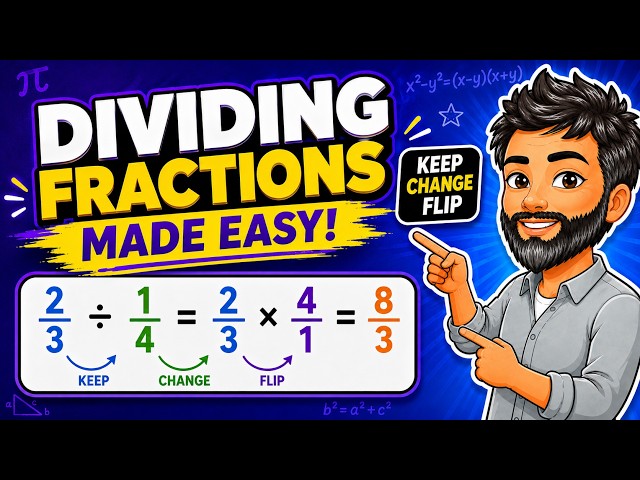
Keep, change, flip
For 7/20 ÷ 5/6, keep the first fraction, 7/20. Change division to multiplication. Flip 5/6 to its reciprocal, 6/5. Now the problem is 7/20 × 6/5.
▶ Watch this step 0:08Look for cross-canceling
Check each numerator against the other fraction's denominator for a common factor. 6 and 20 both have a factor of 2: 6 ÷ 2 = 3 and 20 ÷ 2 = 10. Change them to 3 and 10 to make the multiplying easier.
▶ Watch this step 0:08Multiply straight across
Multiply the numerators and the denominators. 7 × 3 = 21 and 10 × 5 = 50. So 7/20 ÷ 5/6 = 21/50.
▶ Watch this step 0:29Cancel more than once and watch the sign
In the next problem, 8/33 ÷ (−8/9), keep 8/33 and multiply by the reciprocal, −9/8. The two 8s cancel to 1s, and 9 and 33 share a factor of 3, giving 3 and 11. 1 × 3 = 3 and 11 × 1 = 11. A positive times a negative is a negative, so the answer is −3/11.
▶ Watch this step 0:50Change mixed numbers to improper fractions
For 8 9/20 ÷ 1 7/40, first make improper fractions. 20 × 8 = 160, plus 9 is 169, so 169/20. 40 × 1 = 40, plus 7 is 47, so 47/40. Keep the division sign for now.
▶ Watch this step 1:53Keep, change, flip, then cancel
Keep 169/20, change to ×, and flip 47/40 to 40/47. 20 and 40 share a factor of 20, so 20 becomes 1 and 40 becomes 2. Multiply straight across: 169 × 2 = 338 and 1 × 47 = 47, giving 338/47.
▶ Watch this step 2:34Turn the answer into a mixed number
Find how many 47s fit in 338. 47 × 7 = 329, with 9 left over. So 338/47 = 7 9/47.
▶ Watch this step 3:35Write a whole number over 1
For 16/25 ÷ 2, change 2 to 2/1. Keep 16/25, change to ×, flip 2/1 to 1/2. Both 16 and 2 are even, so divide by 2 to get 8 and 1. 8 × 1 = 8 and 25 × 1 = 25, so the answer is 8/25.
▶ Watch this step 4:18

“Don't forget that this is a negative because a positive times a negative is a negative.”
Worked example · with Pi the Owl
Try one more, step by step
Problem: Find 5/12 ÷ 3/4.
- Keep 5/12.
- Change ÷ to ×.
- Flip 3/4 to 4/3: 5/12 × 4/3.
- Cross-cancel: 4 and 12 share a factor of 4, so 4 becomes 1 and 12 becomes 3.
- Multiply straight across: 5 × 1 = 5 and 3 × 3 = 9.
Answer: 5/12 ÷ 3/4 = 5/9
Check: 5/9 × 3/4 = 15/36, which simplifies to 5/12.
Common mistakes
- Dropping the negative sign when one fraction is negative. A positive times a negative is a negative, so write the minus sign on your answer, like −3/11. Mr DJ warns about this
- Flipping the first fraction, or both fractions, instead of the second one. Keep the first fraction exactly as it is. Only the fraction after the ÷ sign gets flipped.
- Flipping a mixed number like 1 7/40 without changing it to an improper fraction. Change mixed numbers to improper fractions first: 1 7/40 = 47/40, which flips to 40/47.
- Treating 16/25 ÷ 2 as 16/25 × 2. Write 2 as 2/1, then flip it to 1/2. Dividing by 2 means multiplying by 1/2.
Questions
What does keep, change, flip mean when dividing fractions?
Keep the first fraction, change the division sign to multiplication and flip the second fraction to its reciprocal. Then multiply straight across. For example, 7/20 ÷ 5/6 becomes 7/20 × 6/5, which is 21/50.
How do you divide a fraction by a whole number?
Write the whole number over 1, then use keep, change, flip. 16/25 ÷ 2 becomes 16/25 × 1/2, and after canceling the 16 and 2 you get 8/25.
Read the full transcript
0:08 Okay, keep change flip. Keep the 720ths. Change division to multiplication. Flip the 56 to its reciprocal of 6 fths. Okay. Look for any reducing or cross-ancelling. 6 and 20 both have a common factor of two. So 6 / 2 is 3. 20 / 2 is 10. So we can change that to a three and that to a 10 to make this easier. Now we're just multiplying straight across. Okay. 7 × 3 gets us 21. 10 × 5 is 50. 7 20ths / 56 is 2150ths 21 over 50
0:58 83 / 8 9th. So keep change flip. So we'll keep 8 33 change division to multiplication and then multiply by its reciprocal which is 9/8. Now we're going to look for any crossancelling. So any common factors with the numerator and denominator, right? Numerator and denominator, numerator and denominator. Um so 8 and 8 both have a common factor of 8. 8 / 8 by 8 is 1. So we can change that to a 1. And we can change this also to a 1 cuz 8id 8 is 1. Now 9 and 33 they have a common factor of 3.
1:43 So 9 / 3 is 3. 33 / 3 is 11. So now multiply straight across. Okay, you get 1 × 3 is 3. 11 × 1. 11 × 1 is 11. And don't forget that this is a negative because a positive × a negative is a negative. So we get a 3 11th. Okay, we have 8 9/20ths / 1 and 7/4ths. So the first thing you want to do is you want to change these mixed numbers into improper fractions. So 20 * 8 is 160 + 9 169.
2:28 And then you keep the denominator the same over 20. Keep the division symbol for right now. 40 × 1 is 40 + 7 is 47. Keep the the denominator stays 40. Now we'll do keep change flip. So we'll keep the 169 over 20. Change the division to multiplication. And we'll flip the 4740ths to 40 over 47. And now we look for any crossancelling. So here we go. The 20 and the 40 have a common factor of 20. Okay, we can change this 20 to a one cuz
3:15 20 divided by 20 is 1. 40 divided by 20 is 2. And then we can multiply straight across. Okay. 169 * 2 was less. So 169 * 2 is um uh 300 and uh 38 and that's going to be over 47. Uh change this from an improper fraction uh to a mixed number at this point. And so 338 over 47 work here. I'm going to do uh 47 * 7. 7 × 7 is 49. 7 × 4 is 28 + 4 is 32.
4:04 So seven of them. So 338 47 is going to be equal to um with uh 47 is going to be the denominator and uh with 9 left over. So 7 and 9 47. Now right away two is the same as 2 over 1. So let's change this to 16 25ths / 2 over 1. Then we're going to do keep change flip. Keep the 16 25ths. Change division to multiplication and flip 2 over 1 to 1 / 2. Now look for any crossancelling. Well 16 and two are both even numbers. So we know two
4:49 hops into both of them or they're divisible by two. Two hops into two one time. two hops into 16 eight times. Then multiply straight across. So 8 × 1 is 8. 25 × 1 is 25. 16 25ths / 2 is 8 25ths.
From the video’s captions.