Step by step
Turn the mixed number into an improper fraction
Before you multiply, change each mixed number into an improper fraction. For 2 1/3, multiply the denominator by the whole number: 3 × 2 = 6. Add the numerator: 6 + 1 = 7. Keep the denominator, so 2 1/3 = 7/3. That works because 2 1/3 is 3/3 + 3/3 + 1/3, and each 3/3 is one whole.
▶ Watch this step 0:43Write the whole number as a fraction
In 2 1/3 × 4, write the 4 as 4/1. Now the problem is 7/3 × 4/1.
▶ Watch this step 1:26Multiply straight across
Multiply the numerators and then the denominators. 7 × 4 = 28 and 3 × 1 = 3, so the product is 28/3.
▶ Watch this step 1:26Convert back to a mixed number
Divide the numerator by the denominator: 28 ÷ 3 is 9 with 1 left over. The leftover becomes 1/3, so 2 1/3 × 4 = 9 1/3.
▶ Watch this step 1:48Convert both mixed numbers
For 1 1/2 × 3 1/4, convert each one. 2 × 1 + 1 = 3, so 1 1/2 = 3/2. 4 × 3 + 1 = 13, so 3 1/4 = 13/4. Multiply straight across: 3 × 13 = 39 and 2 × 4 = 8, giving 39/8, which is 4 7/8.
▶ Watch this step 2:09Simplify if needed
For 2 2/5 × 1 1/2, 5 × 2 + 2 = 12, so 2 2/5 = 12/5, and 1 1/2 = 3/2. Straight across: 12 × 3 = 36 and 5 × 2 = 10, giving 36/10. That is 3 6/10, which reduces to 3 3/5.
▶ Watch this step 3:12Remember the four steps
Mr DJ's review: step one, convert mixed numbers into improper fractions. Step two, multiply straight across. Step three, simplify if needed. Step four, convert back to a mixed number.
▶ Watch this step 3:34

“Before multiplying mixed numbers, we turn them into improper fractions. That's it. That's the secret.”
Worked example · with Blaze the Dragon
Try one more, step by step
Problem: Find 2 1/4 × 1 2/3.
- Convert 2 1/4: 4 × 2 = 8, 8 + 1 = 9, so 2 1/4 = 9/4.
- Convert 1 2/3: 3 × 1 = 3, 3 + 2 = 5, so 1 2/3 = 5/3.
- Multiply straight across: 9 × 5 = 45 and 4 × 3 = 12, giving 45/12.
- Convert back: 45 ÷ 12 is 3 with 9 left over, so 45/12 = 3 9/12.
- Simplify: 9/12 reduces to 3/4.
Answer: 2 1/4 × 1 2/3 = 3 3/4
Check: Estimate: 2 1/4 × 1 2/3 should be a bit more than 2 × 1 1/2 = 3, and 3 3/4 is.
Common mistakes
- Multiplying the whole numbers and the fractions separately, so 1 1/2 × 3 1/4 becomes 3 1/8. Turn both mixed numbers into improper fractions first: 3/2 × 13/4 = 39/8 = 4 7/8.
- Adding 1 instead of the numerator when converting, so 2 2/5 becomes 11/5. Multiply the denominator by the whole number, then add the actual numerator: 5 × 2 + 2 = 12, so 12/5.
- Multiplying the whole number into both the top and bottom, so 7/3 × 4 becomes 28/12. Write the whole number over 1 first. 7/3 × 4/1 = 28/3.
- Stopping at 3 6/10 without simplifying. Check whether the fraction part can reduce. 6/10 reduces to 3/5, so the answer is 3 3/5.
Questions
How do you multiply mixed numbers?
Convert each mixed number into an improper fraction, multiply straight across, simplify if needed and convert back to a mixed number. For example, 1 1/2 × 3 1/4 = 3/2 × 13/4 = 39/8 = 4 7/8.
How do you turn a mixed number into an improper fraction?
Multiply the denominator by the whole number, add the numerator and keep the same denominator. For 2 1/3, that's 3 × 2 + 1 = 7, so 2 1/3 = 7/3.
Read the full transcript
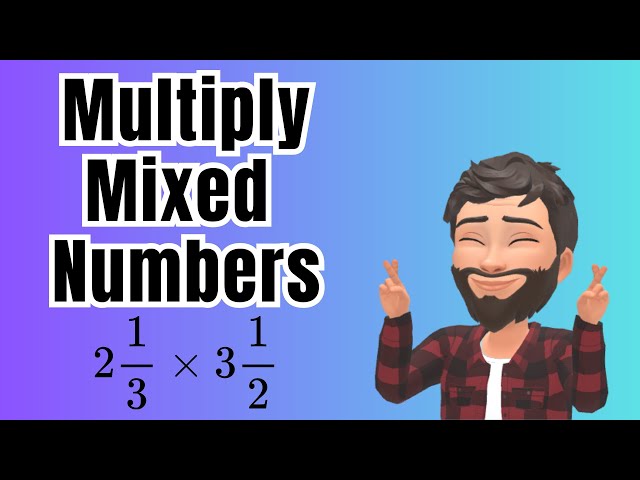
0:03 Welcome back to math with Mr. DJ. Today, we're going to be talking about multiplying mixed numbers. Let me ask you something. Which sounds harder? Multiplying 2 × 3 or multiplying 2 and 1/3 × 3 and 1/2? Yeah. The second one looks a little scary. But, here's the secret. Multiplying mixed numbers is actually easy once you know the steps. And today, I'm going to show you exactly how to do it step-by-step with three examples that will make mixed numbers feel way less intimidating. All right, let's get started. Here's the most important thing to understand. Before multiplying mixed numbers, we turn them into improper fractions. That's it. That's the secret. Because multiplying fractions is much easier. So, let's start off by doing
0:49 quick review on how to turn a mixed number into an improper fraction. First, let's do 3 × 2, which is 6. And then, you do + 1, which gets us 7. And then, you bring the denominator over of 3, and you get 7/3. Then, let's take a look at 2 and 1/3 is the same as 3/3 + 3/3 plus 1/3. Because we all know that 3/3 is one whole, the other 3/3 is one whole, and that's how you get 2 and 1/3. Let's start with the first example. 2 and 1/3 × 4. Step one, turn the mixed number into an improper fraction. 3 × 2 is 6 + 1 is 7. So, we end up getting uh 2 and 1/3
1:35 becomes 7/3. And I'm going to do × 4, which is the same as 4/1. And now, we're going to multiply straight across. 7 × 4 gets us 28. And 3 * 1 gets us 3. So, we get 28/3. And if we're going to convert that back, we would just do 28 / 3. And 28 / 3 is 9 with one left over, so you end up getting 1 uh third for the remainder. So, 9 9 and 1/3. Okay. Now, let's level up. Example number two, 1 and 1/2 × 3 and 1/4. So, again, let's take 1 and 1/2 and convert it into a improper fraction. 2 × 1
2:20 is 2 + 1 is 3, you get 3/2. And now let's do 3 and 1/4. 4 × 3 is 12 + 1 is 13, you get 13/4. So, now we have 3/2 × 13/4. And remember, 13/4 is 4/4 + 4/4 + 4/4 + 1/4, right? That's how we started with 3 and 1/4. And 3/2 is just 2/2 + 1/2. That's how you get 1 and 1/2 to begin with. Now, let us multiply straight across, 3 * 13 and 2 × 4. Well, 3 × 13 is 39, 2 * 4 is 8, and if we that's 39 / 8, so if we um divide that, you end up getting 4 and
3:08 7/8. Okay. So, in this example, we have 2 and 2/5 × 1 and 1/2. So, start off by converting both numbers. 5 × 2 is 10, 10 + 2 is 12, we start off with 12/5. Now, let's convert it 1 and 1/2, 2 × 1 is 2 + 1 is 3, we have 3/2. Then what we're going to do is multiply straight across. 12 × 3 36. 5 × 2 is 10, we have 36/10 right now. Which then gives us 3 and 6/10, which we can then reduce to 3 and 3/5. Let's review the steps. Step one, convert mixed numbers into improper fractions. Step two, multiply straight across.
3:54 Step three, simplify if needed. Step four, convert back to a mixed number. That's the whole process. If you follow those four steps, you can multiply any mixed numbers. If this video helped you understand multiplying mixed numbers, make sure to hit that like button so more students can find this video. And don't forget to subscribe to Math with Mr. DJ. Thanks for watching and I'll see you in the next lesson.
From the video’s captions.