Step by step
Know the parts of the plane
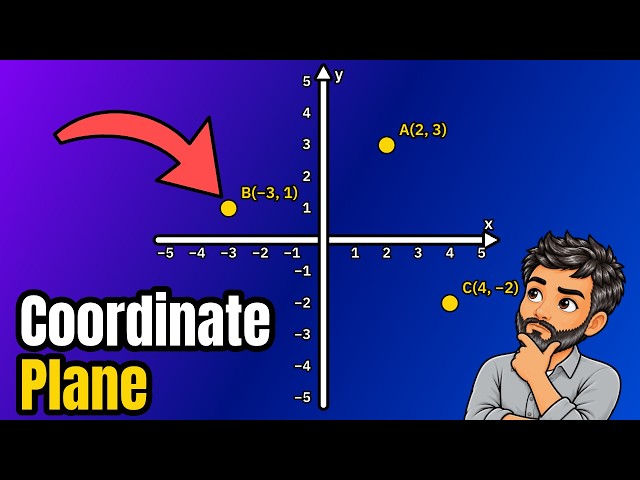
The horizontal line is the x-axis, and the vertical line is the y-axis. They cross at the origin, (0, 0), because that point hasn't moved left or right on the x-axis or up or down on the y-axis.
▶ Watch this step 0:22Read the ordered pair
Every point has an address called an ordered pair, like (3, 4). The x-coordinate always comes first, so 3 is x and tells you left or right. The y-coordinate always comes second, so 4 is y and tells you up or down.
▶ Watch this step 1:03Let the signs set the direction
If x is positive, move right; if x is negative, move left. If y is positive, move up; if y is negative, move down.
▶ Watch this step 1:46Run before you climb
To plot (3, 4), start at the origin. Move 3 units right for x, then 4 units up for y, and mark the point. Always move left or right first, then up or down, so you never switch x and y.
▶ Watch this step 2:07Name the quadrant from the signs
Quadrant 1 is the top right: (positive, positive). Quadrant 2 is (negative, positive), quadrant 3 is (negative, negative), and quadrant 4 is (positive, negative). Since 3 and 4 are both positive, (3, 4) lands in quadrant 1.
▶ Watch this step 2:48Practice in different quadrants
(5, 2) is over 5 and up 2, in quadrant 1. (−3, 6) is left 3 and up 6, in quadrant 2. (7, −2) is over 7 and down 2.
▶ Watch this step 3:51Stay on an axis when a coordinate is 0
For (−5, 0), go left 5, then don't move up or down, so the point sits right on the x-axis. For (0, −5), don't move left or right at all; just go down 5, so the point sits on the y-axis.
▶ Watch this step 4:30

“I like to think, run before you climb. Move left or right first, and then move up or down.”
Worked example · with Pi the Owl
Try one more, step by step
Problem: Plot (−4, −3) and name its quadrant.
- Start at the origin, (0, 0).
- Run first: x is −4, which is negative, so move 4 units left.
- Then climb: y is −3, which is negative, so move 3 units down.
- Mark the point.
- The signs are (negative, negative), so the point is in quadrant 3.
Answer: (−4, −3) is 4 left and 3 down from the origin, in quadrant 3.
Check: Left and down puts the point in the bottom-left part of the plane, where both coordinates are negative.
Common mistakes
- Moving up first, which switches x and y, so (3, 4) ends up at (4, 3). Run before you climb: move left or right for x first, then up or down for y. Mr DJ warns about this
- Moving off the axis when a coordinate is 0, like plotting (−5, 0) above or below the x-axis. A 0 means don't move in that direction. (−5, 0) stays on the x-axis, and (0, −5) stays on the y-axis. Mr DJ warns about this
- Going the wrong way on a negative, like moving right for x = −3. Check each sign before you move: negative x means left, negative y means down.
- Mixing up quadrants 2 and 4. Use the signs: quadrant 2 is (negative, positive) and quadrant 4 is (positive, negative).
Questions
Which comes first in an ordered pair, x or y?
The x-coordinate always comes first and the y-coordinate second. In (3, 4), you move 3 right for x, then 4 up for y.
How do you know which quadrant a point is in?
Look at the signs of its coordinates. Positive x and positive y is quadrant 1, negative x and positive y is quadrant 2, both negative is quadrant 3, and positive x with negative y is quadrant 4.
Read the full transcript
0:02 Coordinate plane explained clearly. By the end of this video, you should be able to understand what the coordinate plane is, know the x-axis and the y-axis, understand ordered pairs, plot points correctly, understand what a quadrant is, and I'm going to help you avoid common mistakes. All right, let's get started. How do people know where points go? Today, we're going to make the coordinate plane easy. Section one. What is the coordinate plane? The coordinate plane is a system mathematicians use to locate points. The horizontal line is called the x-axis. The vertical line, up and down, that's the line is called the y-axis. Where they cross, right here, where they
0:47 cross, that's called the origin. The origin is 0,0 because it hasn't gone left or right on the x-axis, and it hasn't gone up or down on the y-axis. It's right where those two intersect. Section two. Ordered pairs. Let's take a look at 3,4. Every point has an address called an ordered pair. Like, where would 3,4 be on this coordinate plane? Now, remember, the x-coordinate always comes first. So, in this case, the three is the x because that comes first. Then, the y-coordinate always comes second, which is the four. So, you have to remember you have to do the x first, going left and right. In
1:34 this case, we're going to go right because it's positive. And then, you do the y-coordinate, which would be four. And that's either up or down. And in this case, it's up because it's positive. I like to think, run before you climb. Move left or right first, and then move up or down. Section three. Positive versus negative. If x is positive, you move right. If X is negative, move left. If Y is positive, move up. If Y is negative, move down. Section four, plotting a point. Let's plot 3,4. Start at the origin, right here at 0,0. We're going to move three units to the right because we do the X first, then we
2:20 move four units up because we do the Y second. And there's our point. That's where 3,4 would live. Let's talk about common mistakes. One of the biggest mistakes students make is moving up first instead of across first. So, they switch around the X and the Y. So, remember, you need to run before you climb. So, move left or right first, then move up and down. So, be careful of that. That is where most of the mistakes happen. Section five, quadrants. Okay, let's take a look at the quadrants. In the top right, we have quadrant one. That's positive, positive, meaning it's going to be a positive X and a positive Y. In our previous example, we
3:05 had 3,4. That was a positive three and a positive four, so we went to the right three and we went up four. That landed us in quadrant one because both the X and the Y were positive. Quadrant two, that's negative, positive. If an ordered pair has an X that's negative and a Y that's positive, it will always land in quadrant two because you're going to go left first for the X and then you go up for the Y. Quadrant three, negative, negative. When the X is negative and the Y is negative, you will always land in quadrant three. Quadrant four, quadrant four is positive, negative. X is positive, Y is negative, and you will land in quadrant four. Quadrants help us describe where points
3:51 are located. All right. Let's do a few examples. Let's find 5, 2. Where would 5, 2 live? Well, keep in mind we're going to go over 5 on the X, up 2 on the Y. 5, 2 would live right there. What quadrant? Yeah, it'll be in quadrant 1. All right. Now let's locate the ordered pair -3, 6. The X is -3, so we need to go to the left three to to -3, and then we're going to go up six on the Y. Yep, we're in quadrant 2 for -3, 6. Okay, now let's do -5, 0. All right, this one's a little tricky because we have a zero for
4:37 one of our X's or Y's. So, -5 in the X means we're going to go to the left five spots, so to -5. Then, because our Y is zero, that means you're not going up or down. You're actually going to stay right on the X axis and put your point right there. This is where -5, 0 would live. All right, what if we flip-flop those? What if we had 0, -5? Since there's a zero in the X now, you wouldn't go left or right at all. You would just stay right at the origin for that part. Then, -5 for Y means you're going to go down five spots on the Y. So, when you put the point right there on the Y axis.
5:23 What about 7, -2? Again, let's do the X first. So, we're going to go over seven, and then we'll do the Y. We'll go down two. That's where 7, -2 would live. If this video was helpful to you, please take a moment, like, subscribe. I don't want you to miss any of my lessons, and if you have a moment, share them with your friends. The more people I can reach and teach about math, the better. Thank you so much. I really appreciate it and we'll see you in the next lesson.
From the video’s captions.