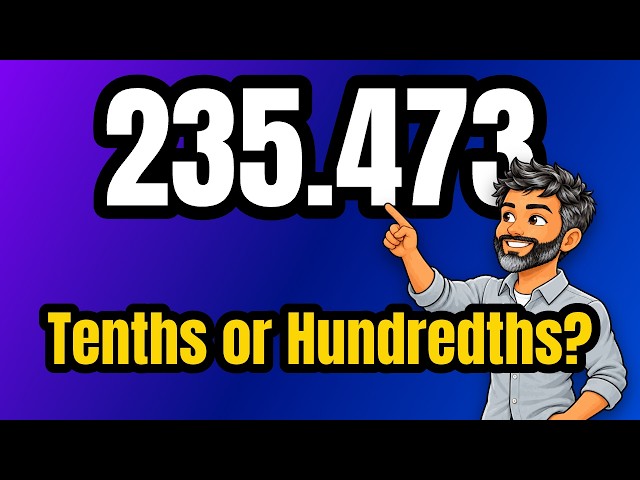
Step by step
Start at the ones place
Mr DJ starts with the ones place. To its left is the tens place, which means 10 ones, and next to that is the hundreds place. He puts 5 in the ones, 3 in the tens and 2 in the hundreds.
▶ Watch this step 0:22Picture it in base ten
He draws dots for ones, long skinny lines for tens and squares for hundreds. 10 single dots equal one line, a ten. 10 of those lines equal one hundred.
▶ Watch this step 1:25Read the whole number
2 hundreds is 200, 3 tens is 30 and 5 ones is 5. Together that is the number 235.
▶ Watch this step 2:30Put the decimal point right of the ones
The decimal point is always to the right of the ones place. A number like 235 does not need to show it, but it still lives there. Once you start talking about parts of a whole, you write it in.
▶ Watch this step 3:14Name the tenths place
The first place to the right of the decimal is the tenths place. There is no "oneths" place. Each tenth is one whole broken into 10 parts, so a 4 there means 4/10, or 0.4. If you had $235 and 4/10, that is $235.40, because you have 4/10 of another dollar.
▶ Watch this step 3:54Add the hundredths place
Next comes the hundredths place: spell "hundred" and add "ths." A 7 there is worth 7/100, or 0.07. Read the number so far as 235 and 47 hundredths, saying "and" when you get to the decimal.
▶ Watch this step 4:58Add the thousandths place
The thousandths place breaks one whole into 1,000 parts. A 3 there is 3/1000, and it would take 997 more of those parts to make a whole. The full number is 235 and 473 thousandths, which equals 235 473/1000.
▶ Watch this step 7:07Place it on a number line
235.473 lives between 235 and 236. The halfway point is 235.5, or 235 1/2, so 235.473 sits a little closer to 235 than to 236.
▶ Watch this step 8:15

“It's always to the right of the ones place, even if you don't see it.”
Worked example · with Blaze the Dragon
Try one more, step by step
Problem: Give the place and value of each digit in 846.192, read it out loud, and say which two whole numbers it is between.
- 8 is in the hundreds place: 800.
- 4 is in the tens place: 40.
- 6 is in the ones place: 6. The decimal point sits right after it.
- 1 is in the tenths place: 1/10, or 0.1.
- 9 is in the hundredths place: 9/100, or 0.09.
- 2 is in the thousandths place: 2/1000.
- Read it as 846 and 192 thousandths, or 846 192/1000.
- It is between 846 and 847. Halfway is 846.5, so it is closer to 846.
Answer: 846.192 is 846 and 192 thousandths, between 846 and 847 and closer to 846.
Check: 800 + 40 + 6 + 0.1 + 0.09 + 0.002 = 846.192.
Common mistakes
- Calling the first place right of the decimal the "oneths" place. There is no oneths place. The ones place jumps straight to the tenths place on the other side of the decimal. Mr DJ warns about this
- Mixing up hundreds and hundredths. Listen for the "ths." Hundreds are left of the decimal; hundredths are two places to the right, and each one is 1/100 of a whole. Mr DJ warns about this
- Thinking the 7 in 235.47 is worth 7 or 70. It is in the hundredths place, so its value is 7/100, or 0.07.
Questions
What is the first place value to the right of the decimal point?
The tenths place. There is no "oneths" place. A digit there tells how many tenths of one whole you have, so a 4 in the tenths place is 4/10, or 0.4.
How do you read 235.473 out loud?
Read the whole number, say "and" at the decimal point, then read the decimal digits with the name of the last place: 235 and 473 thousandths. That equals 235 473/1000.
Read the full transcript
0:01 Hey everybody, welcome back to Math with Mr. DJ. Uh, today we're going to be talking about place value. And in this video, it's place value is so important to understanding number sense. So stick with me here and I think you're going to get a lot out of this video. All right, when we're talking about place value, right, this is the ones place. All right, so let me write and write ones down here. Most people know that right to the left of the ones place, that's your 10's place. And when we're talking about the 10's place, we're talking about 10 1's. Next to that, we're going to have the hundred's place. Hundreds. Now, just to give a little bit
0:46 more information here, let's say we had a five in the ones place. That would be five ones. 1 2 3 4 5. And let's say we had a three in the 10's place. That would be three tens. 1 2 3. And in the hundred's place, let's say we had two hundreds. That would be two hundreds. All right. So, you might be saying to yourself, "Well, Mr. DJ, like why are you drawing dots for the ones place and it's kind of like these longer uh skinny lines for the 10's
1:31 place and these square looking things for the hundred's place. Well, when we're talking about base 10, we we what we're talking about is, you know, like individual cubes for the one place. And I like to draw dots. So for example, you know, one, two, three, four, five, six, seven, eight, nine, 10 of these. 10 of those single dots is equal to one. No, wrong color. Go back. Is equal to one of these lines, right? So that's like a 10. And you can also say 10 of these Um, 10
2:16 of the longs here. 1 2 3 4 5 6 7 8 9 10. 10 of those is equal to 100. So it's important to understand that for place value sake. Okay. Now this number that I have currently written here with the five 1's, three tens and 200s is the number 235 because it has 20 hunds which remember 200s is just 200 and the three 10 is
3:02 30. 30 and the five ones is just five. So it is 20 hunds, 310, 5 1's. Let's start talking about place value with decimals. All right, place value with decimals. Let's put the decimal right here cuz the decimal is always to the decimal is always to the right of the ones place. So it's always like right here. It's always to the right of the ones place. even if you don't see it, even if it's not in the number, like for example, the number 235 wouldn't normally have a decimal place there cuz it's not needed. But once you start talking about um uh the decimal places, you know, fractional parts um
3:49 you know, part of a whole number, you're going to you're going to put the decimal in now, but it's always going to live right there whether you see it or not. Now, let's do this first place value here. This is the tenth's place. Now, sometimes students get a little tripped up and they want to call that like the once place. The once is not a thing. Um, it's it's the ones place and and then it jumps into the 10's place. And the reason why it the first one to the right of the decimal is the 10th's place is because what you're doing is you're breaking up them into 10 parts. like each one is a tenth of one hole. So for example,
4:34 if we have say a four here in the 10th's place, that fourth is this right here individually right here is equal to 4 out of 10 of one whole amount. Right? So like if this was say $235 and410 that's like saying $23540 cuz you have 4/10 of another dollar for example. All right let's keep moving on here. Now let's jump over to the next one. And after the 10th is the hundredth's place. Hundredths place not hundreds hundredths. hundreds
5:20 and it's basically you spell the word 100 oh which I didn't do 100 and then you add ths at the end so it's just hundredth's place and let's say that was a seven there now you have 235 and you want to say the word and when you get to the decimal 235 and 47 hundreds now That seven right there. The value of that seven is 7 out of The value of that seven is 7 out of 100. Hang on. Let me write that out. So the value of that seven is 7 out of 100.
6:05 Again, we had the two hundreds is 200. The 310 is 30. The five 1's is five. And we're going to add on here uh the four 4/10. So it would just be like 4 out of 10. You could also write instead of writing 4 out of 10, you could write um just 0.4. And then for the 700s, you can write um 7 out of 100 like I wrote over there. Or you could also write uh 0.07 here cuz that's 7 hundreds.
6:50 All right, great. Uh let's do one more place value here to uh to the right of the hundredth's place. And all right, let's take a look. Let's do one more. And let's do the thousandth place. And think about that. What does that mean, thousand's place? Well, that just means you're going to break that up into a thousand parts. Okay? And remember, you're spelling thousand uh just spell the word thousand. T H O U S A N D and then add T uh T Hs. Um all right. And let's say we had um a three here. Um and now that would be
7:36 three out of a thousand. Three parts out of a thousand, right? it would take 997 more of those parts to get a whole amount uh if you just had 3,000. Um but in this one we do the whole number altogether is 235 and 473,000. And something really important to understand is that this number right here is equal to this number 235 and 473 over 1,000. All right. this number on the number line right here.
8:22 If you were to put it on a number line, it would live in between the number 235 and the number 236. And if the halfway point between 235 and 236 was 235.5 or 235 1/2, it would live like probably somewhere like right around hereish. All right. So, it's a little bit closer to the 235 than it is to the 236. All right, that's the basics of place value. Very important for having a strong number sense to have all of those memorized. You know, knowing which one is the ones, the tens, the hundreds, and what they mean. And then
9:08 also knowing the tth, hundreds, thousands, um, and what those values are as well. Now, we're not going to get into it in this video, but just know that the that both of those place values go off in both directions in infinite amount of times. So, you know, after the thousand's place is the 10,000's place, then the 100 thousand's place, then the millionth's place, and 10 millions, and so on and so forth. Okay? But for the purposes of this video, we're going to stop it right there. I'll see you in the next video. Make sure you check out my other videos. Don't forget to like, subscribe, leave a comment. Love to hear from you. And again, we'll see you in the next video. Thanks for stopping by.
From the video’s captions.