Step by step
Set up and estimate
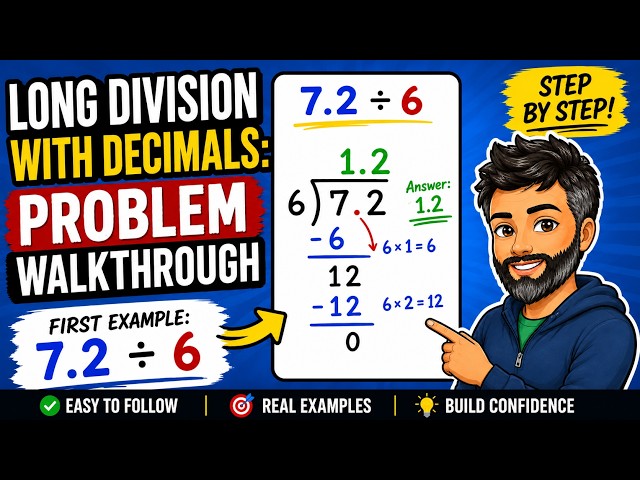
For 7.2 ÷ 6, write the dividend 7.2 inside the division bracket and the divisor 6 outside. Mr DJ thinks of it as breaking $7.20 into six parts, so the answer should be about a dollar something.
▶ Watch this step 0:02Write DMSB
Write D M S B for divide, multiply, subtract, bring down. It helps you keep track of where you are. After each bring down, go back to the beginning and do it again.
▶ Watch this step 0:25Divide, multiply, subtract
Six goes into 7 one time, so write 1 on top. 6 × 1 is 6, and 7 − 6 is 1.
▶ Watch this step 0:46Bring the decimal up, then bring down
Bring down the 2 to make 12. Don't forget to bring the decimal straight up, so it sits just to the right of the 1 in the answer.
▶ Watch this step 0:46Repeat until nothing is left
Six goes into 12 two times. 2 × 6 is 12, and 12 − 12 leaves 0. So 7.2 ÷ 6 = 1.2. That matches the estimate: $7.20 split six ways is $1.20 each.
▶ Watch this step 1:06Skip a digit the divisor can't go into
For 15.75 ÷ 5, five doesn't go into 1, so jump to 15: five goes in 3 times with 0 left. Bring the decimal up, bring down the 7 (one time, 2 left), then bring down the 5 to make 25 (five times). The answer is 3.15. The same steps give 24.64 ÷ 4 = 6.16.
▶ Watch this step 1:27Move the decimal in both numbers
For 18.36 ÷ 1.2, there is a decimal in the divisor. Multiply both numbers by 10 to move each decimal one spot right, making 183.6 ÷ 12. The answer stays the same, just like 20 ÷ 5, 200 ÷ 50 and 2,000 ÷ 500 all equal 4.
▶ Watch this step 4:03Divide the new problem
12 goes into 18 once with 6 left. Bring down the 3 to make 63: five times, 60, with 3 left. Bring the decimal up, bring down the 6 to make 36, which is three times with 0 left. So 18.36 ÷ 1.2 = 15.3.
▶ Watch this step 5:28

“If you move the decimal place in the divisor and the dividend, you'll get the same answer.”
Worked example · with Pi the Owl
Try one more, step by step
Problem: Find 28.56 ÷ 4.
- Estimate: $28.56 split four ways is about $7 each.
- Four doesn't go into 2, so use 28: four goes in 7 times. 7 × 4 = 28, and 28 − 28 = 0.
- Bring the decimal straight up, to the right of the 7.
- Bring down the 5. Four goes into 5 one time. 1 × 4 = 4, and 5 − 4 = 1.
- Bring down the 6 to make 16. Four goes into 16 four times. 4 × 4 = 16, and 16 − 16 = 0.
Answer: 28.56 ÷ 4 = 7.14
Check: 7.14 × 4 = 28.56, and 7.14 is close to the estimate of about 7.
Common mistakes
- Forgetting to bring the decimal point up into the answer. When you reach the decimal in the dividend, bring it straight up into the quotient before you bring down the next digit. Mr DJ warns about this
- Moving the decimal in the divisor but not in the dividend. Move them together. Multiply both by 10, so 18.36 ÷ 1.2 becomes 183.6 ÷ 12, and the answer stays the same. Mr DJ warns about this
- Losing your place halfway through the problem. Write DMSB next to the problem and go back to divide after every bring down.
Questions
Where does the decimal go in long division?
Bring it straight up from the dividend into the answer. In 7.2 ÷ 6, the decimal goes right after the 1 on top, so the answer is 1.2.
How do you divide by a decimal like 1.2?
Multiply the divisor and the dividend by 10 so each decimal moves one spot right. 18.36 ÷ 1.2 becomes 183.6 ÷ 12, which is 15.3, the same answer as the original problem.
Read the full transcript
0:02 Do you know how to break 7 and 2/10 up into six parts? In this video, we're going to do long division with decimals. Let's jump right into it. 7 and 2/10 divided by 6. You're going to write the dividend 7 and 2/10 inside the division bracket and the divisor 6 on the outside. Another way to think about this is how would you break $7.20 up into six parts? $7.20 broken up into six parts is going to be around a dollar something. Now, don't forget to write D M S B for divide, multiply, subtract, bring down. That's going to help us keep track of where we're at in the process in each part. Step two, divide the first digit. How many times does six go into seven? It goes
0:48 in one time because 6 × 1 is 6 and then we'll subtract. 7 - 6 is 1. Bring down the two. Oh, don't forget to bring up that decimal in between the seven and the two there for 7.2. Bring it up so that it's next to the one on the right side of the one. Now, how many times does six go into 12? Six goes into 12 two times. 2 × 6 is 12. Then we're going to subtract that. We have zero remaining. 7 and 2/10 divided by six gets us 1.2 or 1 and 2/10. At the beginning I said think about it as $7.20 broken up into six parts. If you broke $7.20 up into six parts, you'd have a $1.20 in each part. All right. So, for problem number two,
1:34 we have 15 and 75/100 divided by five. Now, you're first going to say how many times does five go into one? Well, five doesn't go into one, so let's just jump to five into 15. Five goes into 15 three times. Write the three above the 15. 3 × 5 is 15. Now, we're going to subtract 15 minus 15 is zero. Now, we get to the decimal and we need to bring that decimal straight up. So, it's going to go to the right of the three up top. And then, we bring down the seven. Now, five goes into seven one time. 1 × 5 is 5. We subtract 7 - 5 gets us two. And then, we bring down the five.
2:20 Five goes into 25 five times. 5 × 5 is 25. Subtract and we get zero remaining. So, $15.75 broken up into five parts is $3.15 or 3.15 or 3 and 3 and 15 hundredths. Problem number three. Let's make it a little bit more difficult. Let's do uh 24 and 64 hundredths or 24.64 divided by four. Let's break that up into four parts. Don't forget to write DMSB. Divide, multiply, subtract, bring down. And remember, after you do the bring down, you're going back to the beginning. So, you'll do it again. Divide, multiply, subtract, bring down.
3:05 All right. Let's get started on problem number three. Four goes into two zero times. So, let's just jump to four into 24. Four goes into 24 six times. 6 × 4 is 24. We're going to subtract 24 minus 24. We get zero. Now, we've hit the decimal. So, we need to bring that up to go to the right of the six up top. Then, we're going to bring down the other six. Four goes into six one time. 1 × 4 is 4. We subtract 6 - 4. We get two. Let's bring down that four. Four goes into 24 six times. 6 × 4 is 24. Subtract, we get zero remaining. 24.64 divided by four is 6.16 or 6 and 16 hundredths. All right. Let's
3:52 move on to the last and final problem. We are going to do 18.36 / 1.2. Okay, so in this one, we have a decimal in the dividend and the divisor. I'll walk you through it. So, when we have a decimal in both the dividend and the divisor, you're going to want to multiply both of them by 10. What we're going to do in this situation is we want to move the decimal over to the right. We want to get the decimal out of the divisor, out of the 1.2. So, we need to multiply both the divisor and the dividend by 10 to move it over one spot to the right. So, by multiplying 1.2 by 10 and 18.36
4:37 by 10, it would allow us to move that decimal one spot to the right on both of them. So, now instead of having 18.36 / 1.2, our new problem is going to be 183.6 / 12. So, that allowed us to get rid of the the decimal in the divisor. You're going to get the same exact answer. It's like saying 20 / 5 is 4 or 200 / 50 is 4. 2,000 / 500 is 4. So, you if as long as you move them together, if you move the decimal place in the divisor and the dividend, you'll get the same answer. So, that's why this works.
5:23 All right, let's get started. 12 doesn't go into one, so let's do 12 into 18. 12 goes into 18 one time. 1 × 12 is 12. Subtract. 18 - 12 is 6. Let's bring down the three. 12 goes into 63 five times. 5 × 12 is 60. We subtract, we get three. Now, we've hit the decimal, so we have to bring that up. Put the decimal on top, right to the right of the five. Bring down the six. 12 goes into 36. 12 goes into 36 three times. 3 × 12 is 36. Subtract, and we have zero remaining. So, 183.6 or 183.6 183 and 6/10 divided by 12
6:09 is 15 and 3/10, which also equals 18.36 / 1.2 is also 15 and 3/10. And there we go. We did four problems dividing with decimals. If you found value in this video, please take a moment and share it with your friends. And don't forget to like and subscribe, and we'll see you in the next video. Thank you so much.
From the video’s captions.