Step by step
Stack the numbers
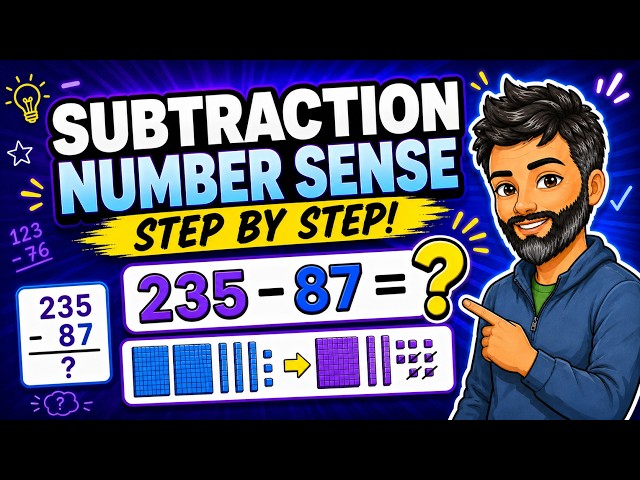
Write 235 on top and 87 underneath, with ones under ones and tens under tens. Start with the ones place.
▶ Watch this step 0:19Borrow a ten for the ones
You can't take 7 ones away from 5 ones, so borrow from the 3 tens. Cross out the 3 and make it 2 tens; that ten goes to the ones, turning 5 into 15. Now 15 − 7 = 8.
▶ Watch this step 0:21Borrow a hundred for the tens
You can't take 8 tens away from 2 tens, so borrow from the hundreds. Cross out the 2 hundreds and make it 1 hundred, which turns the 2 tens into 12 tens. 12 tens − 8 tens = 4 tens, and 1 hundred − 0 hundreds = 1 hundred, so 235 − 87 = 148.
▶ Watch this step 0:42Build 235 with base ten blocks
Now show the same problem with blocks: 2 hundreds, 3 tens and 5 ones. You need to take away 87.
▶ Watch this step 1:07Trade a ten for ten ones
There are only 5 ones, and you need to take away 7. Trade one ten for 10 ones, so you have 15 ones, the same 15 you got by borrowing. Take away 7 ones, and 8 are left.
▶ Watch this step 1:42Trade a hundred for ten tens
Now you need to take away 8 tens but only have 2. It takes 10 tens to make 100, so trade a hundred for 10 tens. That gives 12 tens with only 1 hundred left. Take away 8 tens, and 4 are left.
▶ Watch this step 2:20Read what's left
You have 1 hundred, 4 tens and 8 ones: 148, the same answer the stacking strategy gave.
▶ Watch this step 2:58

“I can't take seven ones away from five ones. So, we need to borrow from the three tens.”
Worked example · with Digit the Fox
Try one more, step by step
Problem: 352 − 76
- Stack it: 352 on top, 76 underneath, ones under ones
- Ones: you can't take 6 from 2, so borrow a ten. 5 tens become 4 tens, and 2 ones become 12. 12 − 6 = 6
- Tens: you can't take 7 tens from 4 tens, so borrow a hundred. 3 hundreds become 2, and 4 tens become 14 tens. 14 − 7 = 7 tens
- Hundreds: 2 − 0 = 2 hundreds
- Read it: 2 hundreds, 7 tens, 6 ones = 276
Answer: 276
Check: Add back: 276 + 76 = 352.
Common mistakes
- Subtracting the smaller digit from the bigger one in each place: 7 − 5 = 2 and 8 − 3 = 5, giving 252. If the top digit is smaller, borrow from the next place. 5 ones become 15 ones, and 15 − 7 = 8.
- Borrowing a ten but not crossing out the 3 tens to make 2, which makes the answer 10 too big (158). Every borrow is a trade: when the ones gain 10, the tens lose 1. Cross out and rewrite right away.
- Thinking the borrowed 1 turns 5 ones into 6 ones. You borrowed one ten, which is 10 ones, so 5 ones become 15 ones, just like trading one ten block for 10 ones.
Questions
What is 235 − 87?
235 − 87 = 148. Borrow a ten so the ones are 15 − 7 = 8, borrow a hundred so the tens are 12 − 8 = 4, and 1 hundred is left.
What does borrowing mean in subtraction?
Borrowing means trading one unit from the next place for 10 of the smaller unit. With base ten blocks, Mr DJ trades one ten for 10 ones and one hundred for 10 tens, which is exactly what crossing out and rewriting does when you stack.
Read the full transcript
0:00 Do you really understand subtraction? Well, in today's video, we're going to do 235 - 87. We'll use the base 10 strategy and we're going to make that connection to the typical algorithm stacking strategy. All right, let's get started. Let's stack this. 200 35 87 Now, I can't take seven away from five ones. So, I can't take seven ones away from five ones. So, we need to borrow from the three tens. Cross out the three tens, make it two tens, and now we've given 10 to the five, which makes 15. So, we can put a one there. We have 15 now. 15 - 7, we can do that. That's eight. We can't take eight tens away from two tens, so we need to borrow from the
0:45 hundreds place. Cross out that two hundreds, make it 100. And we can bring those over to the two tens to make 12 tens. 12 tens - eight tens is four tens. And then 100 - zero hundreds is 100. So, 235 - 87 is 148. So, um Another way to solve this using base 10 strategy, start with um we'll make the number 235. All right. And so, the number 235 right here will be So, that represents two hundred blocks. That represents the three tens.
1:32 That represents the five ones. Now, we need to take away 87 from the 235. I'm going to write it below here. 235. 30 five So, let's start by taking away the seven ones. We have 1 2 3 4 5 ones, but we need to take away seven. So, we need to borrow from here and change that into uh 10 ones. 1 2 3 4 5 6 7 8 9 10. So, that 1 10 turned into 10 ones. And as you can see, we have 15 ones here. If you go back up here, you can see that we had 15 ones when we borrowed. So, now we need to take away the seven ones. So, let's take away seven ones. 1 2 3 4 5 6 7 ones.
2:20 Okay? Um, let me erase this now. Uh, all right. Now, we need to take away eight tens. Well, we can't take away eight tens. So, we have to borrow from here. So, let's borrow a hundred. And these are tens, so it takes 10 tens to make 100. So, we took that 100 and turned it into 1 2 3 4 5 6 7 8 9 10. And as you can see, we have 12 tens now. We have 12 tens up there. We only have 100 left. Yep, only 100 left up there. We have to take away eight of these tens. Let's do that. 1 2 3 4 5 6 7 8. All right. And that leaves us with just uh, 100 48. So, that's how you can solve this using the base 10 strategy. We got 100
3:06 48. 100, four tens, eight ones.
From the video’s captions.