
Step by step
Know what whole numbers are
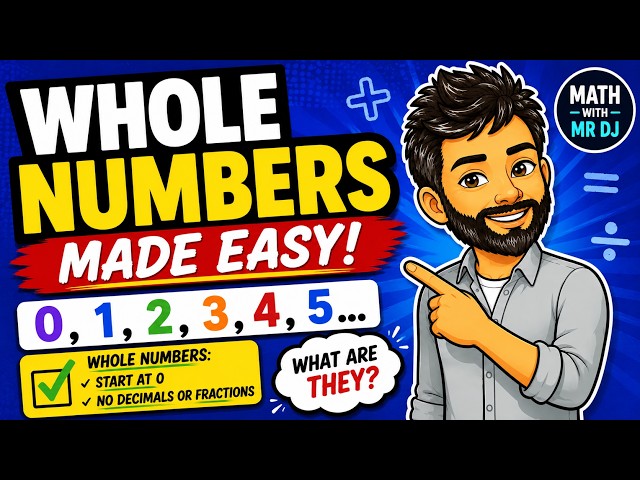
Whole numbers are 0, 1, 2, 3, 4, 5, 6 and so on, going forever in the positive direction. They start at 0, so 0 is included. There are no negative numbers, decimals or fractions in the set.
▶ Watch this step 0:02Write numbers in words, one section at a time
For 84,003,403, focus on everything before the first comma and say 84, then say "million" at the comma. Then read the next section, 3, and say "thousand" at the next comma. Finish with 403: eighty-four million, three thousand, four hundred three. Mr DJ says the number to himself over and over while he writes it.
▶ Watch this step 1:06Write numbers in standard form
Standard form is the regular way you write numbers with digits. 9 billion needs a lot of zeros: 9,000,000,000. Reading the commas from the left, the first is billion, then million, then thousand.
▶ Watch this step 2:09Turn expanded form into standard form
For 600,000 + 80,000 + 3,000 + 500 + 7, you could stack and add, but place value is faster. The largest part is 600,000, so the number has 6 digits: 6 hundred thousands, 8 ten thousands, 3 thousands and 5 hundreds. There is no tens part, so that place is 0. Then 7 goes in the ones: 683,507.
▶ Watch this step 2:51Compare from the greatest place value
To compare 14,680 and 14,519, start in the greatest place. Both have 1 ten thousand and 4 thousands, so you can't tell yet. In the hundreds place, 6 is more than 5, so 14,680 > 14,519. In the same way, 205,321 < 249,065 because the ten thousands digits are 0 and 4.
▶ Watch this step 4:36Find the value of a digit
In 14,053, the 4 is in the thousands place, so there are four thousands. Its value is 4,000, not just a thousand. When a 4 sits in the hundred thousands place, its value is 400,000.
▶ Watch this step 6:43Order from least to greatest
First check whether the question wants least to greatest or greatest to least. For 14, 7, 137,074, 1,008 and 15,603, start with the smallest and cross each one off as you use it: 7, 14, 1,008, 15,603, 137,074.
▶ Watch this step 7:46

“It's not just a thousand cuz there's four of them. It's 4,000.”
Worked example · with Pi the Owl
Try one more, step by step
Problem: Write 500,000 + 90,000 + 1,000 + 40 + 2 in standard form and in words.
- The largest part is 500,000, so the number has 6 digits.
- 5 goes in the hundred thousands, 9 in the ten thousands and 1 in the thousands.
- There is no hundreds part, so write 0 in the hundreds place.
- 4 goes in the tens and 2 in the ones: 591,042.
- Words: say 591 before the comma, then "thousand," then 42.
Answer: 591,042, or five hundred ninety-one thousand, forty-two.
Check: 500,000 + 90,000 + 1,000 + 40 + 2 = 591,042.
Common mistakes
- Saying the value of the 4 in 14,053 is "thousands" or 1,000. The 4 is in the thousands place and there are four of them, so its value is 4,000. Mr DJ warns about this
- Putting numbers in greatest-to-least order when the question asks for least to greatest. Double check which order the question wants before you start. Least means the smallest number comes first. Mr DJ warns about this
- Counting negative numbers, fractions or decimals as whole numbers. Whole numbers start at 0 and only go up by ones: 0, 1, 2, 3 and so on. Mr DJ warns about this
Questions
Is zero a whole number?
Yes. Whole numbers begin at 0 and go 0, 1, 2, 3 and on forever. They do not include negative numbers, fractions or decimals.
How do you compare two large whole numbers?
Start at the greatest place value and move right until the digits are different. For 14,680 and 14,519, the ten thousands and thousands match, but the hundreds digits are 6 and 5, so 14,680 > 14,519.
Read the full transcript
0:02 Everybody, welcome back to math with Mr. DJ. Today we're talking about whole numbers. When we say whole numbers, we're talking about numbers like 0 1 2 3 4 5 6 so on and so forth. It just keeps going on forever in a positive direction. But, keep in mind whole numbers do not have negative numbers. There's no decimals or fractions or like just you know, part of a number. And it begins at zero. So, zero is included in the set. What if you were asked to write each number in words? Right here we have 2,000 376. So, we would write 2,000 then with three hundred
0:49 seventy six. Just like that. And when I'm writing this out, I like to like say the number over and over again to myself. It it helps me write it out. Maybe it'll help you as well. All right, the bottom number here two thousand In this number we have 84 million 3,403. When I'm saying the numbers out, I like to focus on everything before that comma. So, I'll say 84. And then when I get to that comma, I say million. Then I focus on just that section. I'll say three. And when I get to that comma, I'll say the word thousand. Then I'll focus on this section and say 403.
1:35 Let's do that together one more time. All right. 84,000 Just kidding. 84 three thousand 403. Now, let's write it out. 80 84 million 3,000 4 100 3 Excellent. All right, let's move on to the next section. Write each number in standard form. Now standard form is just like kind of like the regular way that you write numbers. So just read it and
2:21 then just write the regular way that we write numbers. So the first one, 4,012. Next one, 9 billion. 9 It has a lot of zeros. 9 billion. Cuz right here the first uh the first comma is billion, then that one is million, and this last one is thousand. All right, let's keep going on. Write each number in standard form. Well, we just talked about that. Standard form is kind of like the regular way you write it. And as you can see here, we have a version of expanded form. So we have 600,000 plus 80,000 plus 3,000 plus 500 plus 7. So knowing place value is going to be really important uh on this. You could always stack these and add them together, but it's much faster if
3:07 you just understand place value. So for example, since the largest number in this set is the 600,000, I know that there's going to be 1 2 3 4 5 6 digits in this number. And the 600,000, the 6 belongs in the 600 the 100,000 place. The 8 is going to go in the 10,000s place. The 3 will go into the thousands place. And then the 5 is going to go in the hundreds place. And then as you can see, we don't have a tens place there. So that's going to have to be a zero. And then the 7 goes in the ones place. So this number is 683,507.
3:55 All right. Now, for this next one, 831 million 453,027. Well, we can just write that one out. 800 31 million 400 53,000 27. Nice. All right, onto the next section. Use less than or greater than to make true. All right. So, we're trying to figure out which numbers are greater and less than each other here. So, we're going to compare them. We have 14,680 14,519. All right. So, which one of these numbers is greater? Well, if you want, you can start
4:41 in uh the greatest place value to see if you can compare them. This one has a one in the 10,000s place. This has a one in the 10,000s place. So, we can't tell which one's greater yet. There's a four in the 1,000s place and a four in the 1,000s place. Woo. Still can't tell which one's greater. This one has a six in the 100s place. This one has a five in the 100s place. Ah, now that means this one is greater. 14,680 is greater than 14,519. All right, now let's compare these two on the end. 14,519 compared with 14,299. Now again, we can't tell which one's greater from the
5:26 the from the 10,000s place cuz they both have ones or the 1,000s place because they both have fours. So, let's just jump to the 100s place. Now, we know this one had a five and this one has a two in the 100s place. So, 14,519 must be greater than 14,299. All right, let's check in with this last one here. We have 205,321 and we're comparing that to 249,065. So, again, let's check the hundred thousands place, a two and a two. You can't tell which one's greater. Then in the ten thousands place, we have a zero and a four. So, the 249,065 must be greater than the 205,321
6:11 and we will show it like this. All right. Now, let's compare these two. 249,065 to 299,900. Well, you can't tell from the two the twos in the hundred thousands place, but when you look at the um ten thousands place, this has a four, this has a nine. You can tell which one's greater. So, the 249,065 is less than 299,900. What is the value of the digit four in each number? So, for this one, you're going to you're again, you're going to need to know place value. So, for example, uh in 14,053, we have the three is in the ones place, the five is in the tens place, the zero is in the hundreds place,
6:58 the four is in the thousands place, and the one is in the ten thousands place. But, for this one specifically, they're asking us what is the value of the digit four. We're only concerned with that four right here. And that four is in the thousands place. So, we're saying that there's four thousands in this number. Or, that the value of that four is 4,000. It's not just a thousand cuz there's four of them. It's 4,000. That's the value of it. Its place value is in the thousands place. Okay. In this bottom number, we have 205,000,009. Now again, we're We're concerned right now with the value of that four.
7:44 Now, that four is in the hundred thousands place. So, we want to know what is the value of that four? Well, it's 400,000s or 400,000. Easy. All right, let's keep going on. Write in order from least to greatest. Okay. So, we have the number 14, seven, 137,074, 1,008, 15,603. And we need to put those in order from least to greatest. Now, don't always double check that cuz sometimes it'll do greatest to least, but right now they want it from least to greatest. And least is the smallest number.
8:29 So, the smallest number here, again, it's just going to be the seven. So, let's check that one off so that we don't um or exit out so that we don't uh lose track of which ones we've done. And now I can tell the next one, it has to be the 14. And then, let's see here, we have 137,074, 1,008, 15,603. Well, 1,008 is the next smallest number. So, 1,008. Then, 15,603 would go next. And then the last one will be I'm going to have to cram that in over here, 137,074. 137,074.
9:14 So, they're going in order from least to greatest now. All right, let's jump down to the bottom set. We have 17, seven, 177, 7,207, and we have 72. And again, we want to put them in order from least to greatest. So, seven is the smallest, again. Then, it's going to go 17. Then we'll put 72. Then 177. And then we have 7,207. There we go. Awesome. All right. Thank you so much for watching. Be sure to check in on our next lesson. Like, subscribe, share with your friends, and we'll see you in the next lesson.
10:00 Take care. Bye.
From the video’s captions.