
Grade 5 · Measurement & Data · 5.MD.B.2
Line Plots with Fractions Worksheets
Free, printable, and ready to teach: a practice worksheet, an exit ticket, and an answer key with step-by-step solutions — plus colorful lesson slides you can edit. Problems climb from Mild to Spicy, with Mr DJ’s worked example on every sheet. No sign-up needed.
 Open the practice worksheet
Download free
- PDFPractice worksheet4 pages · 9 questions
- PDFExit ticket1 page · 4 questions
- PDFAnswer key with step-by-step solutions5 pages · covers every sheet
- PDFLesson slides11 slides · print or present
- PPTXEditable slidesPowerPoint · opens in Google Slides & Keynote
PDFs print on US Letter paper. Free for classroom and home use.
Step-by-step math videos on the Math With Mr DJ YouTube channel →Key idea
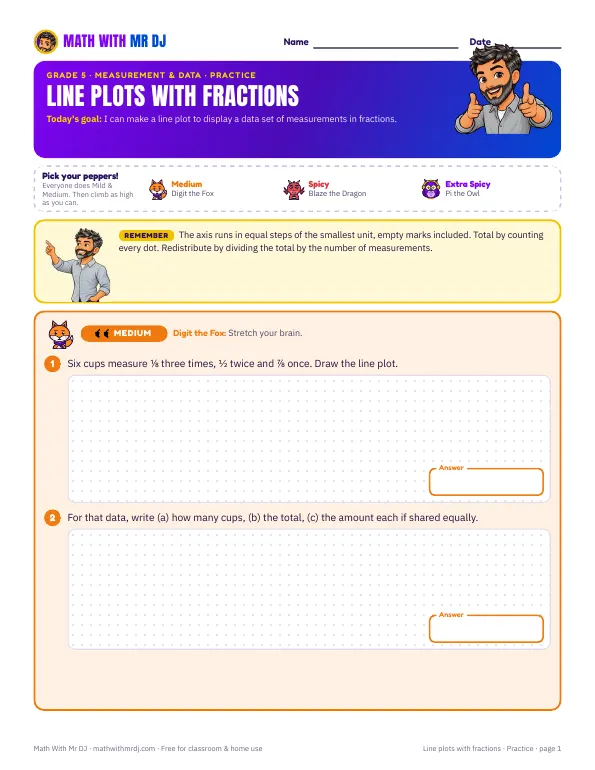
The axis runs in equal steps of the smallest unit, empty marks included. Total by counting every dot. Redistribute by dividing the total by the number of measurements.
Sample problems
- Six cups measure ⅛ three times, ½ twice and ⅞ once. Draw the line plot.
- For that data, write (a) how many cups, (b) the total, (c) the amount each if shared equally.
- For the same data, work out the total by adding the three labels instead. What do you get, and why is it different?
- Eight beakers: ¼ twice, ½ once, ¾ four times, 1 once. Find the total and the equal share.
Common mistakes to watch for
- Answered 2½ for the total — the four labels added once each, with the dot counts ignored. Note this is wrong even though the redistribution question that follows can still come out right.
- Divided by 4 instead of 8, using the number of LABELS. On this data that still gives ⅝ by coincidence; a child who wrote “÷ 4” should be marked on the reasoning even though the answer matches.
- Said Sara “got the right answer so her method is fine”, or corrected the total without explaining the coincidence. The coincidence IS the item: a right answer does not validate a method, which is the same argument as the “Rounding decimals” sheet (Grade 5)’s staging check and the “Relating two number patterns” sheet (Grade 5)’s one-pair rule.
The answer key explains each one, so you can tell what a wrong answer means.
How to use this set
- Teach with the slides (about 15 minutes): a warm-up, the big ideas, a “spot the slip” challenge, Mr DJ’s worked example, and a pick-your-pepper round on whiteboards. Or watch the video together.
- Practice with the worksheet. Everyone does Mild and Medium, then climbs to Spicy and Extra Spicy.
- Check understanding with the exit ticket.
- Mark with the answer key — each answer shows the steps and the most likely mistake. The slides’ teacher notes are in the key too.
More Grade 5 worksheets
All Grade 5 →


Get new worksheets first
New worksheets, videos, and free resources from Mr DJ — about once a month. No spam, ever.