Step by step
Find the mean
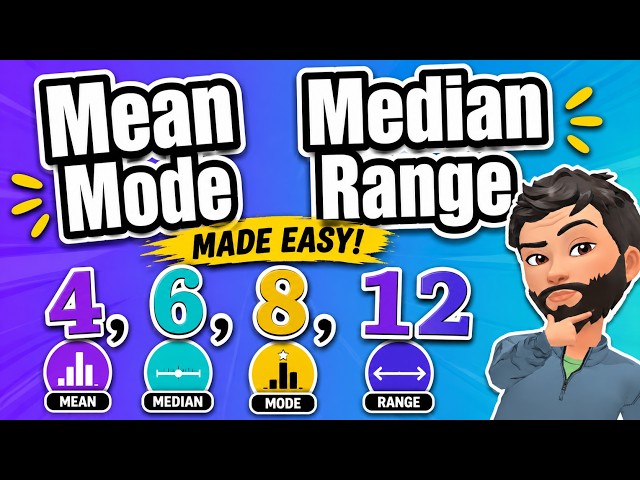
Add all the numbers, then divide by how many there are. For 4, 6, 8, 12: 4 + 6 + 8 + 12 = 30, and there are 4 numbers, so 30 ÷ 4 = 7.5. The mean is sometimes called the average, a kind of balance point.
▶ Watch this step 0:53Find the median
Median means middle. First put the numbers in order from least to greatest. For 3, 5, 7, 9, 11, cross off the 3 and 11, then the 5 and 9, and the 7 is left. The median is 7.
▶ Watch this step 1:46Handle an even number of values
In 2, 4, 8, 10, crossing off 2 and 10 leaves two middle numbers. Find the mean of just those two: 4 + 8 = 12 and 12 ÷ 2 = 6, so the median is 6. The median ignores extreme values called outliers; a 100 in the data would change the mean a lot but usually not the median.
▶ Watch this step 2:34Find the mode
Mode means most. In 2, 4, 4, 5, 7, 7, 7, 9, the 7 shows up three times, more than any other number, so the mode is 7. A data set can have no mode, one mode or more than one.
▶ Watch this step 3:44Find the range
Subtract the smallest number from the largest. For 3, 8, 10, 14, 20: 20 − 3 = 17. The range tells you how spread out the data is.
▶ Watch this step 4:58Find all four together
For 5, 7, 8, 8, 10, 12, 15, the sum is 65 and there are 7 numbers, so the mean is 65 ÷ 7, about 9.3. Crossing off from the ends leaves 8, so the median is 8. The mode is also 8, the only number that appears twice, and the range is 15 − 5 = 10.
▶ Watch this step 5:37Know what each one tells you
The mean is the overall average, the median is the middle value, the mode is the most common value and the range is the spread. Each one gives you a different view of the same data.
▶ Watch this step 7:08

“Each measure gives us a different perspective on the data.”
Worked example · with Blaze the Dragon
Try one more, step by step
Problem: Find the mean, median, mode and range of 11, 4, 9, 17, 6, 9, 14.
- Put them in order: 4, 6, 9, 9, 11, 14, 17 (7 numbers)
- Mean: 4 + 6 + 9 + 9 + 11 + 14 + 17 = 70, and 70 ÷ 7 = 10
- Median: cross off 4 and 17, then 6 and 14, then 9 and 11. The 9 is left
- Mode: 9 appears twice; every other number appears once
- Range: 17 − 4 = 13
Answer: Mean 10, median 9, mode 9, range 13
Check: The mean, 10, falls between the smallest (4) and largest (17) numbers, as a balance point should.
Common mistakes
- Finding the median without putting the numbers in order first. Always arrange the data from least to greatest, then cross off from both ends. Mr DJ warns about this
- Crossing off both middle numbers in an even set, like the 4 and 8 in 2, 4, 8, 10, and having nothing left. Stop when two numbers are left in the middle and find their mean: (4 + 8) ÷ 2 = 6. Mr DJ warns about this
- Thinking every data set has exactly one mode. If every number shows up the same number of times, there's no mode. If two numbers tie for most, both are modes. Mr DJ warns about this
- Counting the two 8s in 5, 7, 8, 8, 10, 12, 15 as one number and dividing 65 by 6. Count every value, repeats included. There are 7 numbers, so divide 65 by 7.
Questions
How do you find the median when there is an even number of values?
Put the numbers in order and cross off from both ends until two are left in the middle. Then find the mean of those two. For 2, 4, 8, 10, that's (4 + 8) ÷ 2 = 6.
What is the difference between mean and median?
The mean adds up all the numbers and divides by how many there are. The median is the middle number once they're in order, so it isn't pulled around by an extreme value like 100 the way the mean is.
Read the full transcript
0:02 Have you ever heard someone say on average blah blah blah this thing happens? Yeah, of course you have. Well, in math there are actually different kinds of averages and each one tells us something different about data. So, today we're going to talk about mean, median, mode, and range. And by the end of this video I I'm really hoping that you'll just know a lot more about what each one means, how to calculate them, and when each one is most useful. All right, let's just jump in. Section one, what are we measuring? All four of these help us understand how to interpret data. For example, we use them for like in quiz scores, the measuring heights, tracking points in a basketball game, the temperature outside. But, large sets of numbers can be hard to understand quickly. So, we use tools to
0:48 like help us summarize all of the data so we can make sense of it. Section two, mean. All right, let's start off with mean. Mean equals the sum of all the numbers, so add them up, divided by how many numbers are in the set. Example one, in this data set we'll have the numbers four, six, eight, 12. To find the mean, we'll add everything together. The four plus the six plus the eight plus the 12 and we'll get 30 in all. Then, step two, divide by how many numbers there are. There are one, two, three, four numbers in this set. The four, the six, the eight, and the 12. So, we will divide 30 by four. When we
1:33 divide 30 by four, we get 7.5 or seven and a half. So, the mean is 7.5. The mean is sometimes called the average because it represents a kind of balance point in the data. All right, let's move on to section three, median. When you think of median, think of the middle number. Median, middle. So, in example two, in our data set we will have the numbers 3, 5, 7, 9, and 11. Now, the median is the middle number, but first, the numbers must be in order from least to greatest. So, if they are not already in order from least to greatest, you want to rearrange them in that way. In this case, we have the 3, the 5, the 7, the 9, and 11. They are in order from
2:19 least to greatest. So, we will start crossing off from both ends. Cross off the 3 and the 11 at the same time. Cross off the 5 and the 9. And what we're left with is the 7. 7 is the median. All right. But what if the set of numbers had an even amount in them when we're looking for the median? So, let's do an example. In this set, we will have 2, 4, 8, and 10. So, we start crossing them off. Cross off the 2, the 10. And wait a minute. There are two middle numbers. If you crossed off the 4 and the 8, you have no numbers left. So, before you cross those off when you're left with two numbers in the middle cuz you started off with an even amount of
3:04 numbers in your data set, you're going to find the mean of just those two numbers. So, the mean of 4 and 8. So, remember, mean is add them up. So, 4 + 8 is 12, and then we're going to divide by two because we're only using those two numbers in the data set to find the mean, and we get 6 for the mean of 4 and 8. Which makes the median of the entire set 2, 4, 8, and 10, the median would be 6 in this case. Median is useful because it ignores extreme values called outliers. For example, the number 100 changes the mean a lot, but it typically wouldn't change the median significantly. Section 4, mode. All right. Mode, when I think of mode, I think of most
3:49 frequent like or mode most. So, it's the number that appears the most in a data set. In our data set, we will have two, four, four, five, seven, seven, seven, and nine. Now, the mode is the number that appears the most. So, in this one, yeah, seven. Seven appears the most. Seven appears three times in this data set. Four appears two times, and the two, five, and nine all appear just once. So, the number that appears the most is seven. Our mode is seven for this data set. All right, keep this in mind though that a mode, you can have no mode for a data set. So, if all of the numbers showed up the same amount of times, there would be no mode. You could have one mode, which we just
4:35 did. Or you can even have multiple modes. So, for example, if we went back to that other that that set we just did with the two, four, four, five, seven, seven, seven, and nine, if we added one more four to that data set, so we had three fours and three sevens, four and seven would be the mode in that case. Section five, range. Now, range is the largest number in the data set minus the smallest number in the data set. So, let's take an example here. Example four, our numbers are three, eight, 10, 14, 20. To find the range, we're going to take the largest number, 20, and subtract the smallest number, three. 20 minus three equals 17. So, the range
5:23 is 17. So, the numbers range 17 numbers. Three the smallest, 20 the largest. That's range. Range tells us how spread out the data is. Section six, whole problem together. Let's find all four. Here's our data set. Five, seven, eight, eight, 10, 12, 15. All right. So, for this one, I want to pause the video and I want you to try this yourself first. I'll wait for you. Okay, did you give it a shot? All right, let's go over it. Mean, did you add them all up? Did you add up 5 + 7 + 8 + 8 + 10 + 12 + 15?
6:09 And you got 65? And then, once you had 65 you divided 65 by 7 because there was seven numbers in the data set and you got approximately 9.3 or 9 and 3/10? All right. So, the mean is approximately 9 and 3/10. The median. Did you arrange the data from least to greatest and then cross off from the ends? And then you were left with the eight? All right, mode. Which number showed up the most times in the data set? Like, which one was the most frequent number? Yeah, eight was. Right? Eight showed up twice. Every other number only showed up one time. Range. Range, remember range is the greatest
6:55 number minus the smallest number. So, 15 minus 5 would give us a range of 10. So, to review, the mean 9.3 median eight mode eight range 10. All right. Section seven. But, how do we know which one we should use? Well, mean is overall average median is the middle value mode is the one that's most common and range is the spread of data. So, each measure gives us a different perspective on the data. That's why statisticians often use all four together. All right, let's wrap it all up. Today we learned mean median, mode, and range. And more importantly you learned what they actually mean about data. Remember, math gets easier when
7:41 you focus on understanding patterns instead of memorizing rules. And depth is more important than speed. So, keep practicing, always be curious, and never stop learning. If this video helped you, give it a like, subscribe to the channel so you don't miss any of my future math lessons. Thank you. We'll see you in the next lesson.
From the video’s captions.