Step by step
Multiply before you add
In 6 + 2 × 3, multiplication comes before addition, so 2 × 3 = 6, then 6 + 6 = 12. Mr DJ reads it as six singles plus two groups of three.
▶ Watch this step 0:03Do grouping symbols first
In (6 + 2) × 3, the parentheses come first: 6 + 2 = 8, then 8 × 3 = 24. Same numbers, different answer, because grouping changes the meaning.
▶ Watch this step 0:30Learn the four levels
First grouping (parentheses), then exponents, then multiplication and division on the same level, then addition and subtraction on the same level. That's PEMDAS.
▶ Watch this step 0:57Multiply and divide left to right
In 18 ÷ 3 × 2, the division comes first reading left to right, so 18 ÷ 3 = 6, then 6 × 2 = 12. Multiplying first would give 18 ÷ 6, which is the trap.
▶ Watch this step 1:44Add and subtract left to right
Addition and subtraction share a level too. In 20 − 8 + 3, do 20 − 8 = 12 first, then 12 + 3 = 15.
▶ Watch this step 2:27Do exponents before × and ÷
An exponent counts equal factors: 3² means 3 × 3, which Mr DJ draws as three rows of three, or nine squares. In 4 + 3² × 2, do 3² = 9 first, then 9 × 2 = 18, then 4 + 18 = 22.
▶ Watch this step 2:49Work brackets from the inside out
Brackets act like parentheses but let you put groups inside groups. In 30 − [6 + 2 × (5 − 2)²] ÷ 3, start with the innermost group: 5 − 2 = 3. Then the exponent, 3² = 9, then multiply, 2 × 9 = 18, and add, 6 + 18 = 24. That leaves 30 − 24 ÷ 3. Division comes before subtraction, so 24 ÷ 3 = 8 and 30 − 8 = 22.
▶ Watch this step 3:43

“Just be careful. You go left to right.”
Worked example · with Pi the Owl
Try one more, step by step
Problem: 20 − (2 + 1)² ÷ 3 × 2
- Grouping first: 2 + 1 = 3, so you have 20 − 3² ÷ 3 × 2
- Exponent next: 3² = 3 × 3 = 9, so you have 20 − 9 ÷ 3 × 2
- ÷ and × share a level, so go left to right: 9 ÷ 3 = 3, giving 20 − 3 × 2
- Multiply: 3 × 2 = 6, giving 20 − 6
- Subtract: 20 − 6 = 14
Answer: 14
Check: Multiplying 3 × 2 before dividing would give 20 − 9 ÷ 6 = 18.5, so the left-to-right order matters.
Common mistakes
- Adding first in 6 + 2 × 3 and getting 8 × 3 = 24. Without parentheses, multiplication comes before addition: 2 × 3 = 6, then 6 + 6 = 12. Mr DJ warns about this
- Multiplying first because M comes before D, so 18 ÷ 3 × 2 turns into 18 ÷ 6. × and ÷ are on the same level. Go left to right: 18 ÷ 3 = 6, then 6 × 2 = 12. Mr DJ warns about this
- Adding first in 20 − 8 + 3 because A comes before S, getting 20 − 11 = 9. + and − are on the same level too, so go left to right: 20 − 8 = 12, then 12 + 3 = 15. Mr DJ warns about this
- Reading 3² as 3 × 2 = 6. 3² means 3 × 3 = 9, nine squares in a 3-by-3 picture.
Questions
Is 6 + 2 × 3 equal to 12 or 24?
It's 12. Multiplication comes before addition, so 2 × 3 = 6 and 6 + 6 = 12. You only get 24 when there are parentheses: (6 + 2) × 3 = 24.
Does multiplication always come before division in PEMDAS?
No. They are on the same level, so you do whichever comes first reading left to right. In 18 ÷ 3 × 2, divide first to get 6, then multiply to get 12.
Read the full transcript
0:00 order of operations. Let's jump right into it. We have 6 + 2 × 3 = what? Remember, multiplication comes first in PEMDAS. We have parentheses, exponents, multiplication and division, addition and subtraction. So, yes. You're going to want to do 2 × 3 first, and that gets you 6. And then you get 6 + 6. That gets us 12. 6 + two groups of three is what it's saying. We have six singles. We have two groups of three. So, 6 + 2 × 3 gets us 12. All right, example two. Now we have grouping symbols. We have the parentheses. Remember, we have to do parentheses first. So, in this one, you're going to do 6 + 2. Gets us eight, and then we have times three. 8 × 3 is 24. Done. Remember,
0:46 grouping changes the meaning. So, without parentheses, you're going to do the multiplication first right here. And with parentheses, you're going to do that first. Here are our order of operations. Grouping, right? That's our like parentheses. Uh then we have exponents. And then we have uh multiplication and division on the same level. And we have addition and subtraction. PEMDAS. Super quick side note on a project I'm really excited about. Take a look. Don't forget, we just launched mathwithmrDJ.com. Go check it out. We have tons of free practice worksheets for kindergarten through eighth grade. And we also have some really great new puzzles. So, if you like doing puzzles like shape scales
1:31 and figuring those out, we also have the area blocks puzzle. We also have equation guest. It's a lot like Wordle, but for numbers. All right, let's jump right back into our PEMDAS, our order of operations. Example three. Equal priority. We have 18 / 3 × 2. Now, we said before that division and multiplication are on the same level. So, it just depends on which one comes first if we're reading from left to right. So, looking at this one, we see that the vision happens first. So, you have to do 18 / 3 first. 18 / 3 gets us 6. And then we have times 2. Then we do 6 * 2. That gets us 12. Done. Here's a common multiplication trap. 18 / 3 × 2
2:17 does get us 12. We just did it. Incorrect would be doing 18 / 6 because you did the multiplication first. We just talked about that. Just be careful. You go left to right. Example four, addition and subtraction. Those are on the same level. It's the same deal. You're just going left to right when it's addition and subtraction. So, you're going to have to do the 20 - 8 first. It's 12. And then we still have + 3. And 12 + 3, that gets us 15. Done. Exponents count equal factors. Look, 3² means 3 × 3. So, look, we have 1 2 3 × 1 2 3. It's 3 × 3. Three rows of three. 3²
3:05 is 9. It literally means nine squares. 1 2 3 4 5 6 7 8 9. Example five, an exponent. So, we have 4 + 3² × 2. Now, remember in PEMDAS, right, we said that exponents are right here. Exponents. So, if there's no parentheses, exponents have to happen next. So, you have to do 3². That gets us 9. We bring everything else down. Then we have to do the multiplication. So, 9 × 2 goes next. That's 18. We have 4 + 18. 4 + 18 is 22. Again, done. Let's go. Example six. Whoa, look at this one. It's getting harder. All right. So, we've got all kinds of things happening. We got uh parentheses, um the
3:52 brackets, and we have uh more exponents. So, all right. So, remember the brackets uh right here and right here. Um those act as like the same as the parentheses. They just might allow you to have like groups inside groups, which is what's happening here. So, we have to do what's inside the brackets first. So, we're just looking right now at this section right here. Now, looking inside just that section of the brackets, you can see there's parentheses inside those brackets. So, now you can't just look at that whole thing. You just have to look at just this part. Cuz you have to solve that first. So, 5 - 2 gets us three. And since that's solved, we can put the squared right there. And
4:38 then we have times 2 + 6. And again, I want to take care of everything inside these brackets first. Uh, 3 squared has to come next because that is an exponent. So, that gets us nine. Times 2 + 6. Then we have to take care of the 2 × 9. That's 18. And then 6 + 18 gets us 24. So, okay, everything inside the brackets has been solved to 24. So, I am going to now, for space purposes, going to erase all this. And let's write this here. All right. So, now all of this goes away and it's been solved to 24. So, now we have 30
5:24 24 / 3. And we need to do 24 / 3 first because division happens before subtraction. 24 / 3 that gets us eight. And we have 30 - 8, which is 22. Boom. Quick check before we keep going on. Don't forget, first you have to do grouping, inside and out. Two, exponents. Three, multiplication and division. Remember, they're on the same level, so we go left to right. So, number four, we have addition and subtraction. Same thing. We go left to right. So, whatever happens first as you're reading like left to right. This one's for you, so I want you to try this one at home. You can put your answer in the comments. For the mild and medium problems, I will put I will do those answers right here. Then,
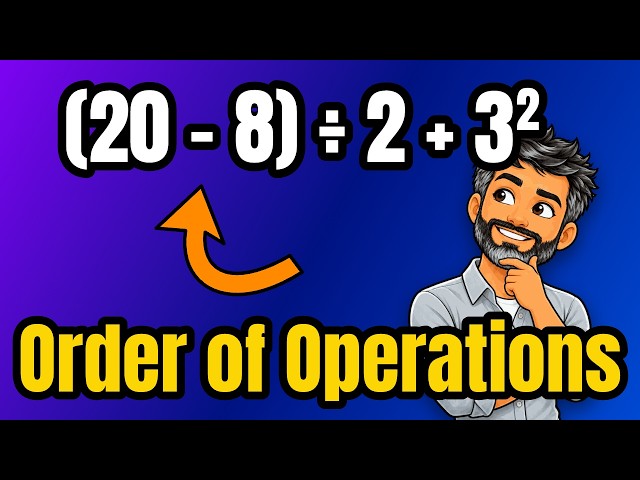
6:10 for the spicy one, I'm going to leave that one in the comments. But, I want you to try these ones. So, go ahead, pause the video if you happen uh pause the video. Try it out. All right. Hopefully, you paused the video and tried it. But, first, we're going to do multiplication, right? 4 × 3, that's 12. 8 + 12 is 20. Did you get that? All right, here's your medium one. So, now they're adding in parentheses and some exponents. So, again, pause the video. Try it out. Parentheses first. 20 - 8, 12. Then, divided by 2 + 3 squared. We do the 3 squared, that gets us 9. And then, we bring everything else down. Then, we do 12 / 2 is 6. 6 + 9, that gets us 15. Did you get 15
6:57 for that one? Bam. Spicy problem. Okay, see, I'm not going to do this one right now, though. So, you're going to do this one. Your answer in the comments. Tell me what you got. Even if you check my answer, I want you to put your answer in the comments, too. So, we can see like what everybody gets. Here's the mild answer we just talked about, 20. The medium answer was 15. And your spicy answer, once again, that will be in the comments. Don't forget to check out Math with Mr. DJ. I have the the puzzles, I have worksheets, uh all kinds of stuff, and I'm adding more things. You can sign up for the email list, too. Um don't forget to like and subscribe. I really appreciate everybody who keeps coming back to watch these videos. Share this with your friends. We'll see you in the next lesson. Take care. Bye.
From the video’s captions.