
Grade 8 · Statistics & Probability · 8.SP.A.4
Two-Way Tables Worksheets
Free, printable, and ready to teach: a practice worksheet, homework, an exit ticket, and an answer key with step-by-step solutions — plus lesson slides you can edit. No sign-up needed.
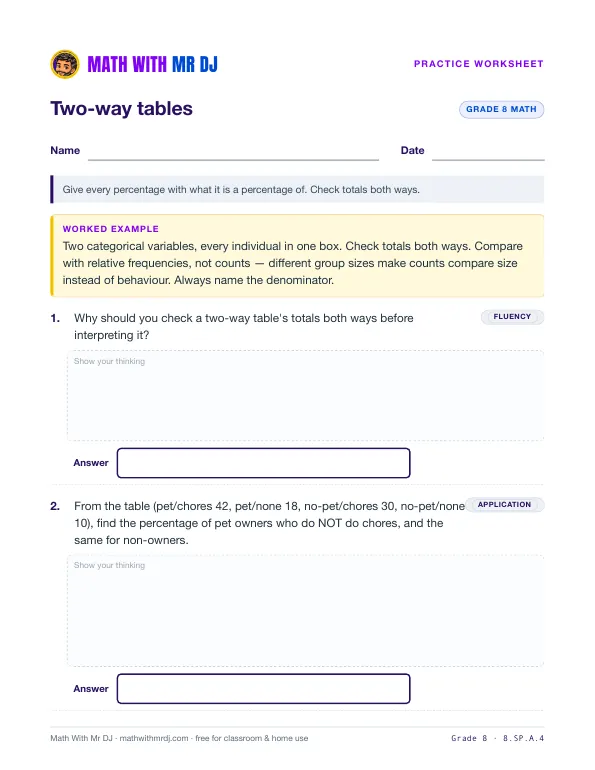 Open the practice worksheet
Download free
- PDFPractice worksheet4 pages · 9 questions
- PDFHomework3 pages · 8 questions
- PDFExit ticket2 pages · 4 questions
- PDFAnswer key with step-by-step solutions10 pages · covers every sheet
- PDFLesson slides8 slides · print or present
- PPTXEditable slidesPowerPoint · opens in Google Slides & Keynote
PDFs print on US Letter paper. Free for classroom and home use.
Step-by-step math videos on the Math With Mr DJ YouTube channel →Key idea
Two categorical variables, every individual in one box. Check totals both ways. Compare with relative frequencies, not counts — different group sizes make counts compare size instead of behaviour. Always name the denominator.
Sample problems
- Why should you check a two-way table's totals both ways before interpreting it?
- From the table (pet/chores 42, pet/none 18, no-pet/chores 30, no-pet/none 10), find the percentage of pet owners who do NOT do chores, and the same for non-owners.
- Add your two answers to the row percentages from the exit ticket. What do you notice, and why must that happen?
- Explain why comparing 42 with 30 compares the group sizes rather than the chore habit.
Common mistakes to watch for
- Omitted the totals, or reached different grand totals by the two routes. Adding both ways is the check, and it costs seconds.
- Divided both by 100, giving 42% and 30% — the share of ALL students, which does not compare the two groups. The denominator has to be the group you are describing.
- Said she should have used percentages, without giving them. The two rates are the argument, and the important observation is that the answer reverses — counts here are not merely imprecise, they are misleading.
The answer key explains each one, so you can tell what a wrong answer means.
How to use this set
- Teach with the slides (about 15 minutes), or watch the video together.
- Practice with the worksheet. Questions climb from fluency to application to reasoning.
- Check understanding with the exit ticket, and send the homework home.
- Mark with the answer key — each answer shows the steps and the most likely mistake.
More Grade 8 worksheets
All Grade 8 →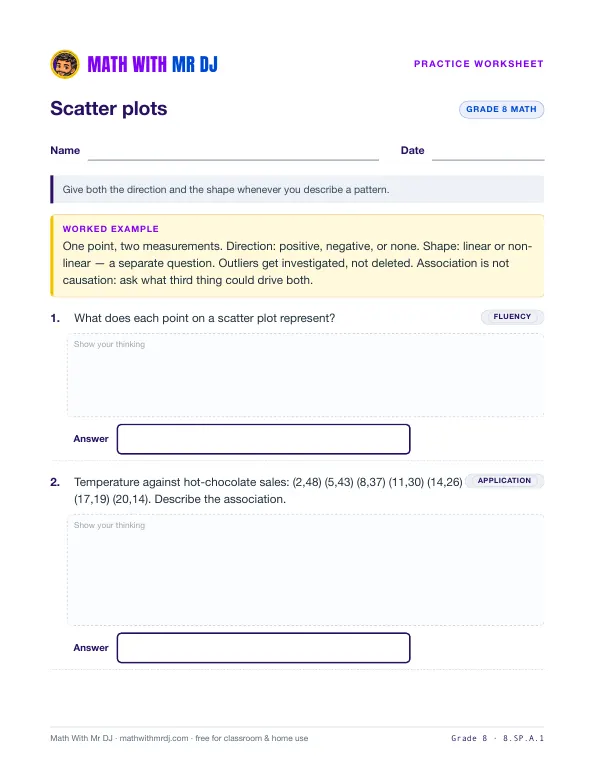 Scatter Plots8.SP.A.1 · Practice · Homework · Exit ticket · Answer key · Slides
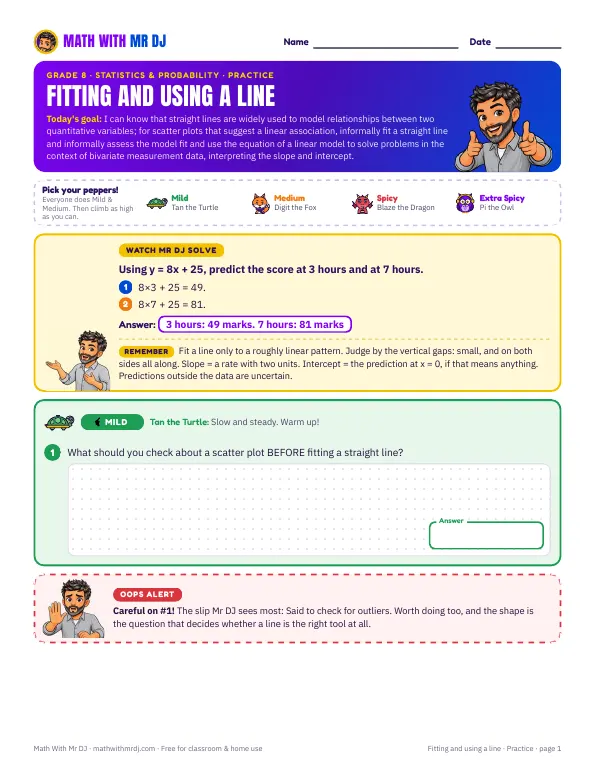 Fitting and Using a Line8.SP.A.2 · Practice · Homework · Exit ticket · Answer key · Slides
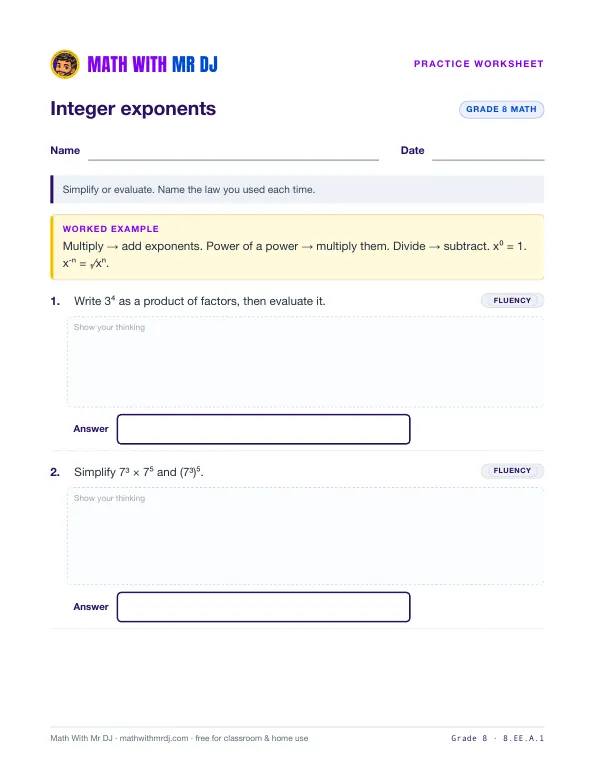 Integer Exponents8.EE.A.1 · Practice · Homework · Exit ticket · Answer key · Slides
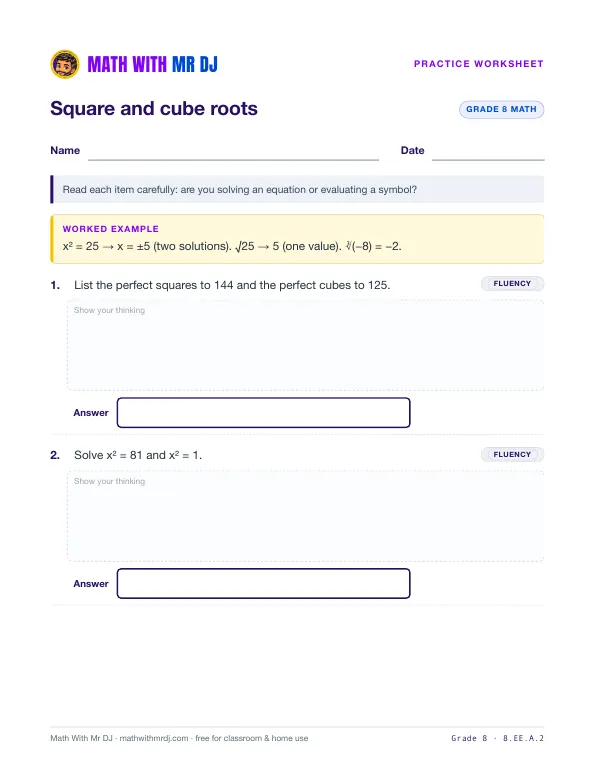 Square and Cube Roots8.EE.A.2 · Practice · Homework · Exit ticket · Answer key · Slides▶ Video lesson
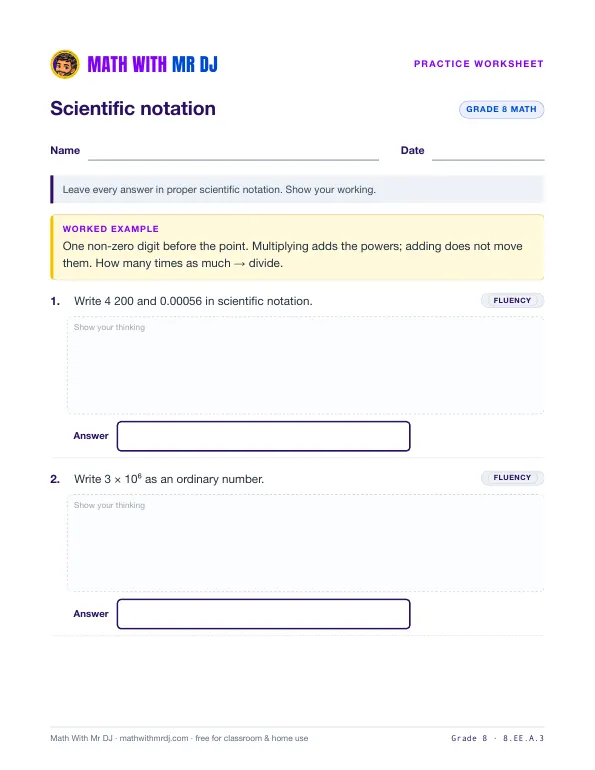 Scientific Notation8.EE.A.3 · Practice · Homework · Exit ticket · Answer key · Slides
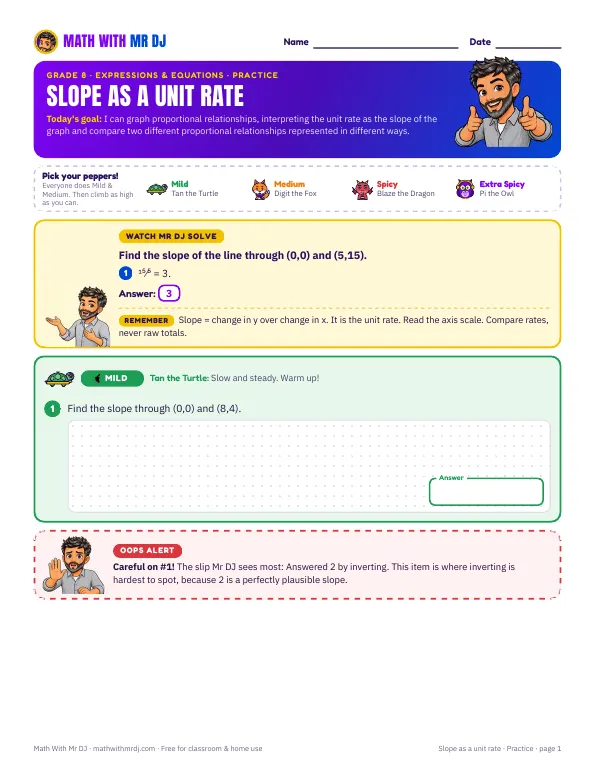 Slope as a Unit Rate8.EE.B.5 · Practice · Homework · Exit ticket · Answer key · Slides


Get new worksheets first
New worksheets, videos, and free resources from Mr DJ — about once a month. No spam, ever.