
Grade 8 · Statistics & Probability · 8.SP.A.1
Scatter Plots Worksheets
Free, printable, and ready to teach: a practice worksheet, homework, an exit ticket, and an answer key with step-by-step solutions — plus lesson slides you can edit. No sign-up needed.
 Open the practice worksheet
Download free
- PDFPractice worksheet4 pages · 9 questions
- PDFHomework3 pages · 8 questions
- PDFExit ticket2 pages · 4 questions
- PDFAnswer key with step-by-step solutions10 pages · covers every sheet
- PDFLesson slides8 slides · print or present
- PPTXEditable slidesPowerPoint · opens in Google Slides & Keynote
PDFs print on US Letter paper. Free for classroom and home use.
Step-by-step math videos on the Math With Mr DJ YouTube channel →Key idea
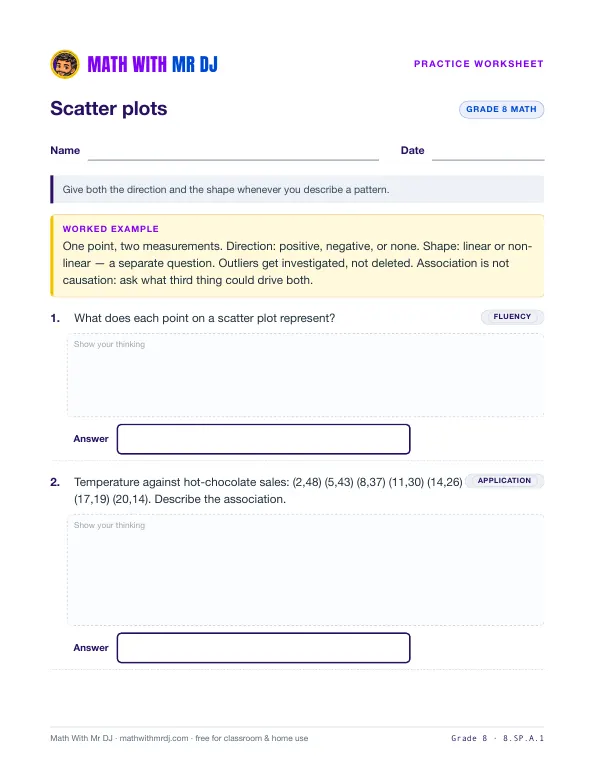
One point, two measurements. Direction: positive, negative, or none. Shape: linear or non-linear — a separate question. Outliers get investigated, not deleted. Association is not causation: ask what third thing could drive both.
Sample problems
- What does each point on a scatter plot represent?
- Temperature against hot-chocolate sales: (2,48) (5,43) (8,37) (11,30) (14,26) (17,19) (20,14). Describe the association.
- Explain the difference between a negative association and no association.
- Why are direction and shape two separate questions? Give a pattern that is positive but not linear.
Common mistakes to watch for
- Gave only “positive”. Direction alone is half the description, and the shape is what decides whether a straight line may be used later.
- Said to remove it so the pattern is clearer. That is the misconception exactly — an outlier is data, and a pattern made tidy by deletion is no longer a description of what happened.
- Wrote “correlation is not causation” and stopped. The phrase is correct and it demonstrates nothing — the question asks for a third thing, and naming hot weather is what shows the idea is understood rather than remembered.
The answer key explains each one, so you can tell what a wrong answer means.
How to use this set
- Teach with the slides (about 15 minutes), or watch the video together.
- Practice with the worksheet. Questions climb from fluency to application to reasoning.
- Check understanding with the exit ticket, and send the homework home.
- Mark with the answer key — each answer shows the steps and the most likely mistake.
More Grade 8 worksheets
All Grade 8 →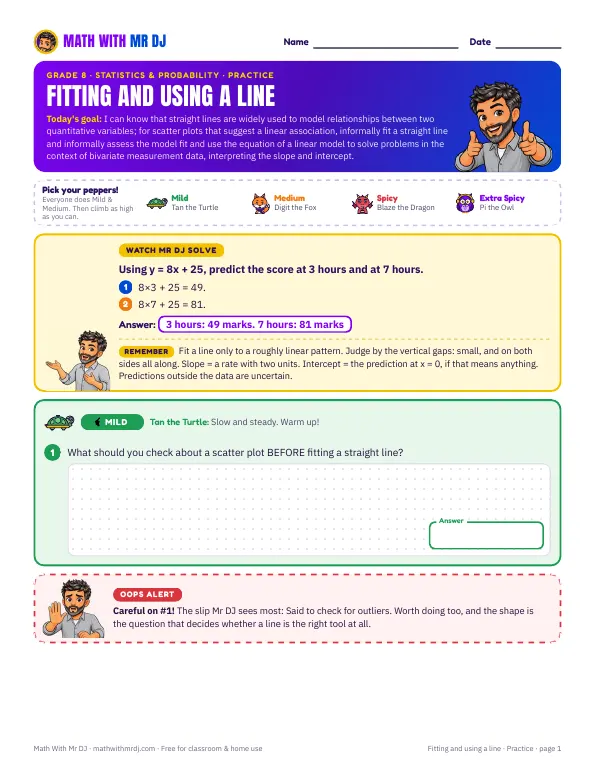 Fitting and Using a Line8.SP.A.2 · Practice · Homework · Exit ticket · Answer key · Slides
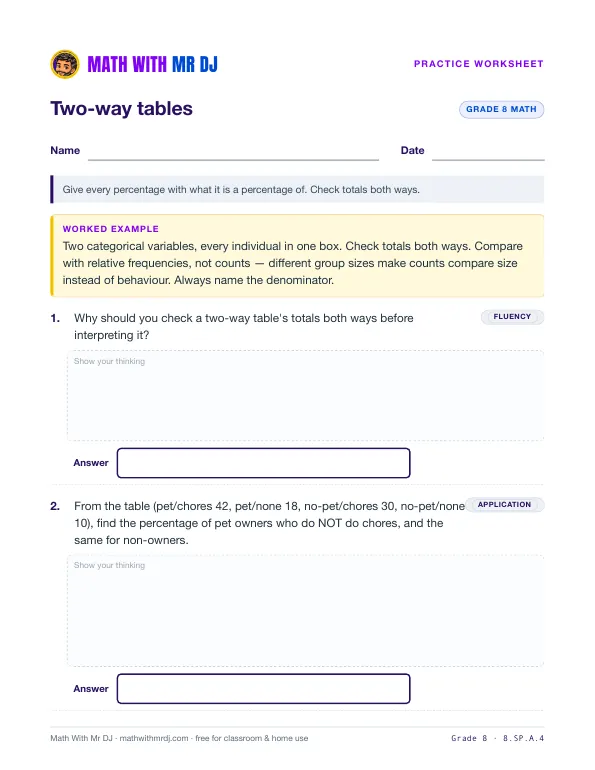 Two-Way Tables8.SP.A.4 · Practice · Homework · Exit ticket · Answer key · Slides
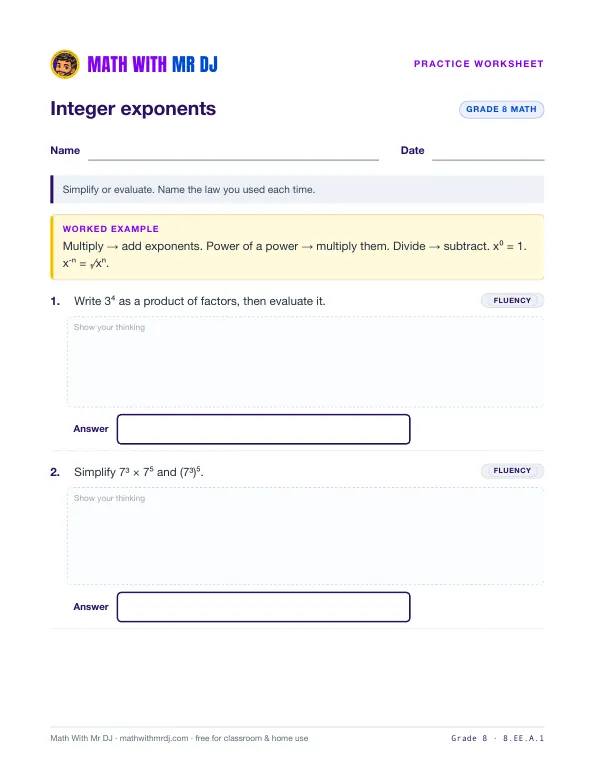 Integer Exponents8.EE.A.1 · Practice · Homework · Exit ticket · Answer key · Slides
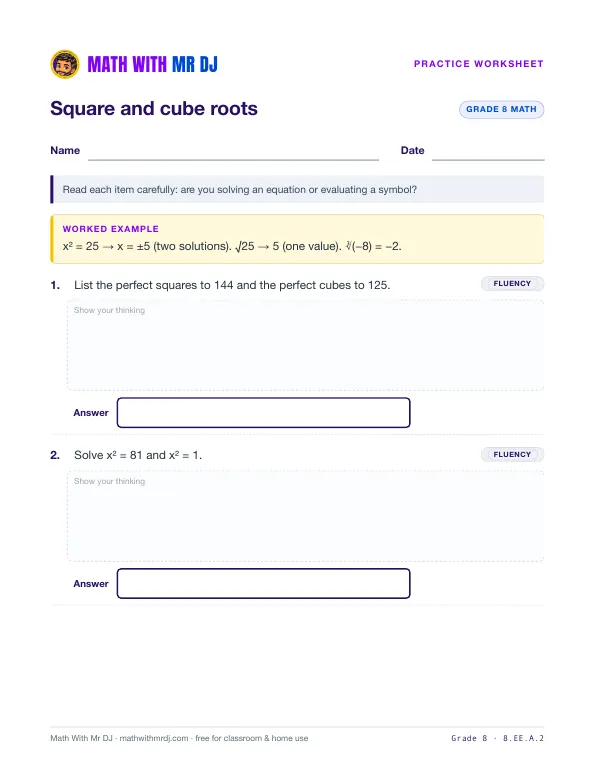 Square and Cube Roots8.EE.A.2 · Practice · Homework · Exit ticket · Answer key · Slides▶ Video lesson
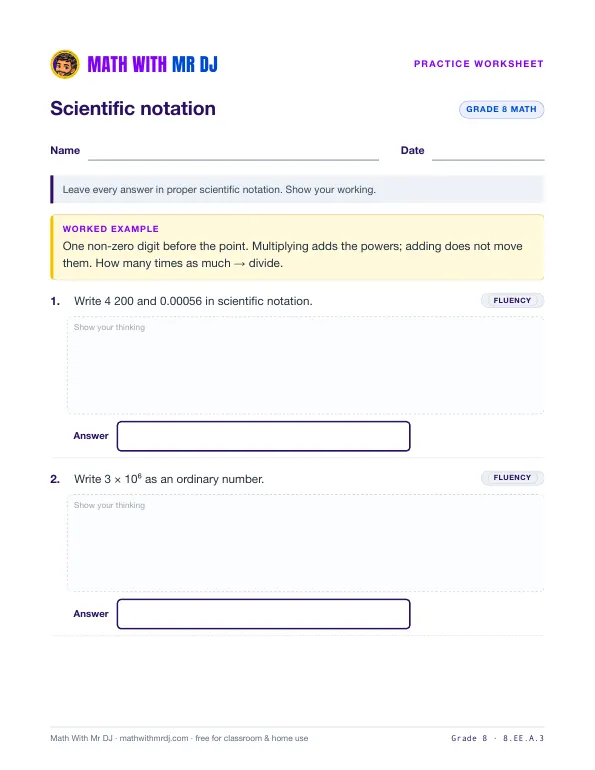 Scientific Notation8.EE.A.3 · Practice · Homework · Exit ticket · Answer key · Slides
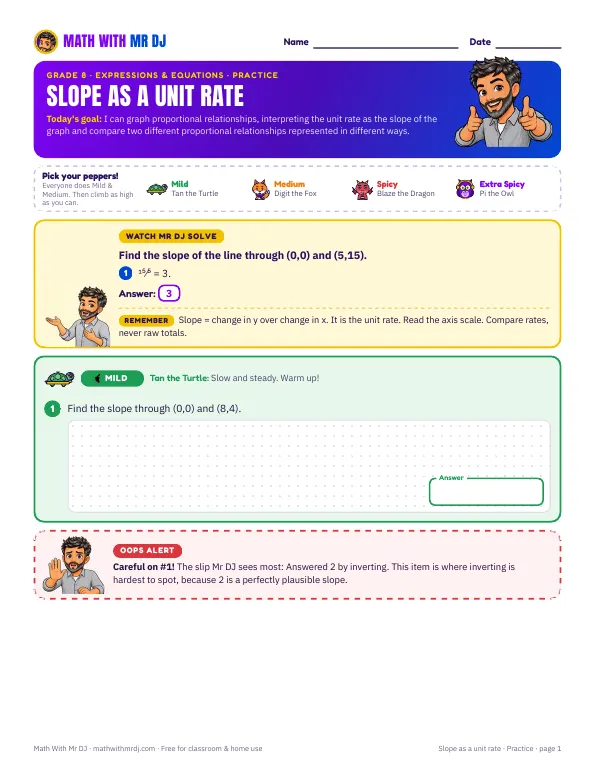 Slope as a Unit Rate8.EE.B.5 · Practice · Homework · Exit ticket · Answer key · Slides


Get new worksheets first
New worksheets, videos, and free resources from Mr DJ — about once a month. No spam, ever.